
SecondSource · July 24, 2026 — Washington Names a Name: The U.S. Says China's Kimi K3 Was Built by "Distilling" Claude; Sanctions Are on the Table, No Evidence Shown
The White House's top technology-policy official has named names: Moonshot AI, the Chinese lab behind Kimi K3, allegedly "distilled" Anthropic's
At a glance
- The White House's top technology-policy official has named names: Moonshot AI, the Chinese lab behind Kimi K3, allegedly "distilled" Anthropic's Claude to build its frontier model. The Treasury Secretary put sanctions and the Entity List (Commerce's export blacklist) on the table the same day. The U.S. showed no evidence, and dissenting experts argued the same day that distillation can't explain K3's capability. If your company runs on Chinese open-source models, start building a fallback today.
- Four models anyone can rent aced the world's hardest math competition with simultaneous perfect scores, and "accuracy" has stopped discriminating among frontier models. Right on cue, the evaluation group METR shipped a new yardstick: how much money does an AI have to spend to match a human at the same task? The model-selection question changes: stop asking for the score, ask for the cost curve.
- "Will Chinese price cuts destroy the AI business" got its first quantified answer: a 10% cut in token prices (the metered unit that AI text processing is priced in) lifts usage roughly 11% (NBER) to 18% (Exponential View) — two methods that can't be averaged, but both point the same way: total spend rises rather than falls. Price cuts are a volume engine, not a deflationary spiral.
Source base: the July 24, 2026 research daily; primary event dates July 20–23, with retrospective material tagged by original publication date. Overnight into this morning we processed 18 pieces: 12 podcast transcripts (2 yielded no signal) plus 6 industry newsletters, with 2 more newsletters fetched July 22 handled in the same pass → 32 linked receipts in this issue. In the interest of transparency: leads 2 and 4 and the first Research Watch item rest mainly on relays from a single theZvi weekly roundup, with the primary sources not yet individually retrieved; the accusation in lead 1 has been checked verbatim against the official primary post.
Today's leads
1. [This week] (posted Jul 23) Three months ago Washington would say only that it had evidence and would act, naming no one. Today that became a named accusation — and a specific one. Michael Kratsios, director of the White House Office of Science and Technology Policy (OSTP) and the most senior technology-policy official in the executive branch, posted from his official account: "We have information that Moonshot AI distilled Anthropic's Fable for the development of its K3 model." Distillation, in plain terms, means training your own model on another model's answers — effectively siphoning off its capability; whether that constitutes intellectual-property theft is precisely what's at issue here. The accusation has three parts: beyond the distillation itself, Kratsios says Moonshot built a sophisticated large-scale distillation platform that let it "quickly switch between multiple methods of access to avoid detection," and that it acquired export-controlled Nvidia GB300 servers and "accessed GB300s in Thailand" (Kratsios's primary post, Jul 23). Treasury Secretary Scott Bessent put the enforcement tools on the table the same day — "open source is not open season on American IP" — declining to rule out sanctions and the Entity List, the Commerce Department's export blacklist, which requires U.S. companies to obtain special licenses before exporting to listed entities (Bessent's remarks relayed via theZvi's weekly, Jul 23). Our July 22 issue covered the mechanics of this distillation debate and the restrictionist winds in Washington; what's new today is two things: a named target, and sanction tools formally on the table. Verification: Two layers need separating. That the accusation happened is solid: we checked Kratsios's post word for word against the official account. Whether the accusation is true is far from settled: the U.S. did not explain how it knows and produced no evidence, Moonshot has not responded, and TechCrunch published dissenting expert opinion the same day arguing K3's capability level can't be explained by distilling one frontier model (TechCrunch, Jul 23). We retain both sides. As of press time: sanctions and the Entity List remain threats, with no formal action taken. Judgment update: The policy line has escalated from general declaration to named accusation — a structural step. If you use or are evaluating Chinese open-source models like Kimi K3: the day the Entity List goes from threat to action, API supply chains and compliance reviews get hit, and you should already have an alternative track in hand. One read pointing the other way: policy analyst Peter Wildeford estimates (relayed via the same weekly) that K3 still clearly trails the strongest U.S. models by roughly six months; the notion that distillation alone buys parity doesn't square with that observation.
2. [This week] (test run published Jul 23, via relay) Four models any member of the public can rent hit a perfect 42/42 on the IMO at the same time — "accuracy" has lost its power to discriminate among frontier models. The International Mathematical Olympiad (IMO) is the world's hardest high-school math competition and a long-standing benchmark for AI reasoning. In 2025, AI's best result was 35/42, and it came from two unreleased experimental models; this year, a public test run by tech investor Deedy showed four publicly available models all scoring a perfect 42/42, at roughly $10 to $50 per attempt (theZvi's weekly, Jul 23). Each had its signature: Anthropic's Fable 5 was fastest and passed in one shot; OpenAI's GPT-5.6 Sol was cheapest; China's Kimi K3 also aced it but needed four extra attempts and burned the most tokens; the startup Axiom Math completed everything as machine-verifiable formal proofs. Our July 20 issue noted that Axiom's self-reported perfect score had gone days without independent confirmation; this run matches its self-report, though the run itself is still a single-source relay. The same week, METR — an independent research group best known for measuring how long a task — in the time a human would need — an AI can complete autonomously — introduced a new yardstick, the "expenditure horizon": however much an AI spends on a single task, its performance tends toward a ceiling, while humans given enough investment eventually pull ahead — so measure instead how much an AI must spend to match a human on the same task. Its demonstration task is a public NanoGPT training-optimization research problem; on it, the best models spend roughly $2,000–3,000 to match a human (same weekly cited above). Verification: Every number in this item comes through a single relay in theZvi's weekly; we have not yet directly checked Deedy's solution logs or METR's original release — treat as directional. METR itself flags two reservations: the demonstration task is public and models may be overtrained on it; and it calls on vendors to publish full cost curves answering "how much better does more money buy." Judgment update: We are recording a new judgment (our own synthesis — not any outside expert's words): the axis of frontier-capability comparison is migrating from accuracy to the cost of reaching human-equivalent results. The evidence is thin — both supporting facts are single-source relays — so we log it at low confidence. If it holds, the next round of model competition will sell cost-efficiency curves, not peak scores; if you buy models for a company, the diligence question can change today: a perfect score is the ticket in, and you should ask vendors for per-task cost at your target quality.
3. [This week] (published Jul 23) Cut token prices 10% and usage climbs: an NBER paper puts the rise at about 11% (elasticity –1.11), Exponential View's own report at 12–18%. Either way, the price war can't kill the token business. Our July 21 issue spent a full edition asking whether Chinese models are actually cheap; the open-source world's hottest question this week is the sequel: will Kimi K3's aggressive pricing break the business of selling tokens? The tech-analysis newsletter Exponential View gives a quantified answer: no. Its own industry report measures token consumption rising 12–18% for every 10% price cut; a National Bureau of Economic Research (NBER) working paper independently estimates usage up about 11% per 10% cut — an elasticity of –1.11 in the economist's terms: every 1% price drop lifts usage 1.11%. One caveat: –1.11 pencils out close to break-even (elasticity just above the critical value of 1), so on its own it only establishes "not a collapse-grade decline"; what actually supports "total spend rises" is EV's 12–18%-per-10%-cut range (Exponential View, Jul 23). The two figures come from different methodologies — one an industry report, one academic econometrics — and can't be averaged into a single number, but they point the same way: cuts drive volume. The same piece adds the supply side of the ledger: free weights do not mean free deployment. Self-hosting a model like K3 — 2.8 trillion parameters, with weights alone occupying 1.4 TB — takes a GB200 NVL72-class 72-GPU rack: roughly $3–4M to buy outright, about $7M a year to rent on the open market, before counting networking, storage, cooling, and staff. Verification: Both elasticity figures (EV's 12–18% and NBER's –1.11) are relayed through the same Exponential View article; the 12–18% is its own report's number, with a self-reported component, and we have not yet checked the NBER paper against the original. The self-hosting costs are the author's engineering estimate; the 2.8-trillion-parameter spec is consistent with Bloomberg's earlier relay, and the remaining hardware and power figures have no second source. Judgment update: For cloud providers selling inference, –1.11 is today's number to remember: falling unit prices get eaten back by usage growth, so the pricing objective is a race between how fast unit costs fall and how fast usage grows — not defending a unit price. For anyone choosing a platform: "open source has no license fee" is not "open source has no cost" — the real self-hosting bill belongs in the spreadsheet. Read this alongside the deep dive below: upstream is issuing debt to keep compute alive, downstream token prices are diving while total usage climbs; whether the conversion belt in the middle — usage becoming payment — holds is what the deep dive's three verdict signals will answer: whether high-tier net revenue retention holds 85%, what spreads and terms the bond market sets once free cash flow hits zero, and whether a second revenue curve beyond coding emerges.
4. [This week] (effective Jul 20) Anthropic made its strongest model permanent on subscription plans. Unusually, it also said why: demand is hard to predict, so capacity ships in stages. Anthropic officially announced that Claude Fable 5 is permanent on Max and Team Premium plans as of July 20, metered at half the usual allowance — meaning using Fable draws down your allowance at twice the rate; Pro plans continue to access it via usage credits plus a one-time $100 credit; Claude Code weekly limits rise 50%, extended through August 19. The official explanation is unusually plain: "Demand for Fable has been challenging to predict, which is why we rolled it out to subscription plans in stages, extending access several times as we secured additional capacity." Anthropic engineer Thariq described keeping it permanent as an effort running "literally around the clock" (official posts relayed via theZvi's weekly, Jul 23). Verification: A company's official statement about its own product — high credibility; but we saw it through the weekly relay and have not obtained a direct link to the original announcement. Judgment update: Read with lead 1: the same model appears in two stories today — on one side a capacity bottleneck where demand outruns supply, on the other the alleged distillation target. Per the same weekly relay, Anthropic is tightening external disclosure of its models' reasoning process as an anti-distillation measure, with a real usability hit on some tasks. The costs of both theft-prevention and capacity expansion land on the same paying developers; Anthropic owes them a clear product answer, or the biggest casualty of the accusation episode will be its own customers' experience. Enterprise Claude customers can watch two signals: whether Claude Code weekly limits tighten again, and whether external reasoning-process disclosure recovers after the anti-distillation squeeze — together they measure how much of this trade-off ultimately lands on customer experience. (Our call.) If Claude availability tightens under anti-distillation measures and rate limits, enterprises comparing agent products will find their alternative mainly with OpenAI's ChatGPT or Codex.
5. [This week] (evaluation published Jul 23, via aggregated relay) A Reddit local-model hobbyist ran Poolside's new open-source Laguna S through a private test suite: fast, best-in-class tool calling — and three fabrications under pressure. Poolside, the AI coding company, released its small open-source model Laguna S 2.1 last week; our July 23 issue logged the official self-description, and what's new today is the first non-vendor evaluation. A user in Reddit's local-model community ran it against a private test suite: slightly faster than the comparable Qwen (109 versus 103 tokens per second) and the best tool calling in the lineup — but under deliberately applied pressure it fabricated facts three times, versus zero for Qwen. The evaluator's diagnosis is memorable: it "overthinks math and underthinks facts"; after configuration fixes, 125 reruns still left one fabrication standing (AINews, Jul 23). The community's overall verdict: very attractive for local deployment, but the official benchmarks look "too good to be true." Verification: A single user's private test suite, relayed through AINews's aggregation; no standard third-party evaluator has replicated it, and three-versus-zero is a tiny sample — a signal, not a verdict. Judgment update: Acceptance testing for open-source models is spinning off into an independent axis: beyond size and speed, behavior quality under stress needs its own check. This is also the first counter to Poolside's own story: its founder argues the model's capability comes from post-training behavior shaping, and the first community test found precisely a behavioral defect. For enterprise evaluators and buyers: make fabrication rate under pressure a standalone acceptance item — don't stop at speed and tool-call success rates.
Also on the radar
- [This week] (interview published Jul 22) Poolside founder Kant — in the same interview our July 23 issue quoted for his tooling-layer claims — offered a training-side judgment: the real bottleneck in reinforcement-learning training is the wall clock; batch size has a mathematical ceiling, adding GPUs can't buy time, and the frontier race is actually denominated in calendar days. Self-interested, single source (Latent Space interview, Jul 22)
- [This week] (aggregated Jul 23) A relayed claim about a Google internal security tool: calling small specialized models up to five times each and aggregating the results found 55 confirmed vulnerabilities in Chrome's engine — beating a larger general-purpose model's 47 and Claude Opus 4.6's 36. Single relay, and cross-vendor comparisons carry heavy motivated bias (AINews, Jul 23)
- [This week] (reported Jul 23) Veteran venture firm IVP, per confidential fundraising documents, is raising a new $1.8B fund: the portfolio includes a significant Anthropic investment though not the largest-shareholder stake, and the firm appears to have missed OpenAI and SpaceX (Newcomer, Jul 23)
- [Evidence update] (original claim April 2026) Directed verification of the Altimeter analyst's "AI value inverted triangle" framework is complete: Nvidia's company-wide 75.0% gross margin is confirmed in the earnings original — it serves as an approximation of data-center margin, since Nvidia doesn't disclose segment margins; "hyperscalers account for roughly half of data-center revenue" is backed by the CFO's own words on the earnings call; "roughly $350B added over two years, with 75% flowing to the chip layer" has no independent second source and remains a one-party estimate (Nvidia earnings release; call transcript; original analysis)
- [Evidence update] (original January 2025) Recheck of Dwarkesh Patel's "fully automated AI firm" thought piece: the original text and its quotes check out; there is serious independent criticism but no refutation; as forward-looking speculation that present facts cannot adjudicate, it stays on file at low confidence (original)
Deep dive
Core judgment: In the second half of 2025, four heavyweights — investor Brad Gerstner, enterprise-search company Glean's CEO Arvind Jain, Michael Dell, and Nvidia CEO Jensen Huang — each used independent math to argue the same thing: compute isn't overbought, it's underbought, and $2–5 trillion a year is the justified investment level. But all four calculations lean on the same pillar: enterprises will pay something close to the value of the productivity gains. Reconciled against mid-2026, the answer breaks into three layers. Layer one is settled: the shovel-sellers have fully delivered. Layer two is messier — conversion on the paying side isn't one number but a curve stratified by price tier. And the structure of the money has put a clock on the whole debate.
Why we're digging now: Fresh evidence for all three layers converged this week. Supply delivered first — Nvidia's data-center revenue hit $75B in a single quarter, up 92% year over year, annualizing to roughly $300B and arriving three to four years ahead of the level Wall Street had originally penciled in for 2029 (Nvidia earnings call, May 2026). Conversion stratifies sharply by price tier: enterprise AI tools priced above $250/month post 70% gross revenue retention (GRR — the share of revenue retained from existing customers) and 85% net revenue retention (NRR — which also counts existing customers buying more), already at traditional B2B SaaS levels — against a base where median gross retention across AI-native startups has only climbed from 27% in January 2025 to 40% in September, the mid tier ($50–249/month) sits around 45%, and the sub-$50 tier is leaking at 23% (a16z; ChartMogul). The bear flagship — MIT's "95% of enterprise pilots fail" — has been publicly challenged on methodology and downgraded to a contested signal (HPCwire); the harder countercase is now Danish national administrative data: in ChatGPT's first two years on the market, income effects above 2% can be ruled out (NBER working paper). And what actually started the clock is the structure of the money — hyperscaler capex is already consuming 90% to 100% of operating cash flow, with combined free cash flow projected to hit zero around Q3 2026 (Epoch AI) and debt taking over from there: an estimated ~$489B of AI-related bonds in 2026 (Yahoo Finance, citing Goldman Sachs estimates). What used to be an open-ended wait for conversion data is now a race with a deadline: the diffusion speed of high-tier conversion against the tightening speed of financing terms. A coda on one falsifiable call: Gerstner's prediction that capex would peak at 66% of operating cash flow and then recede has been refuted by three independent sources — BofA, Epoch, and Oracle.
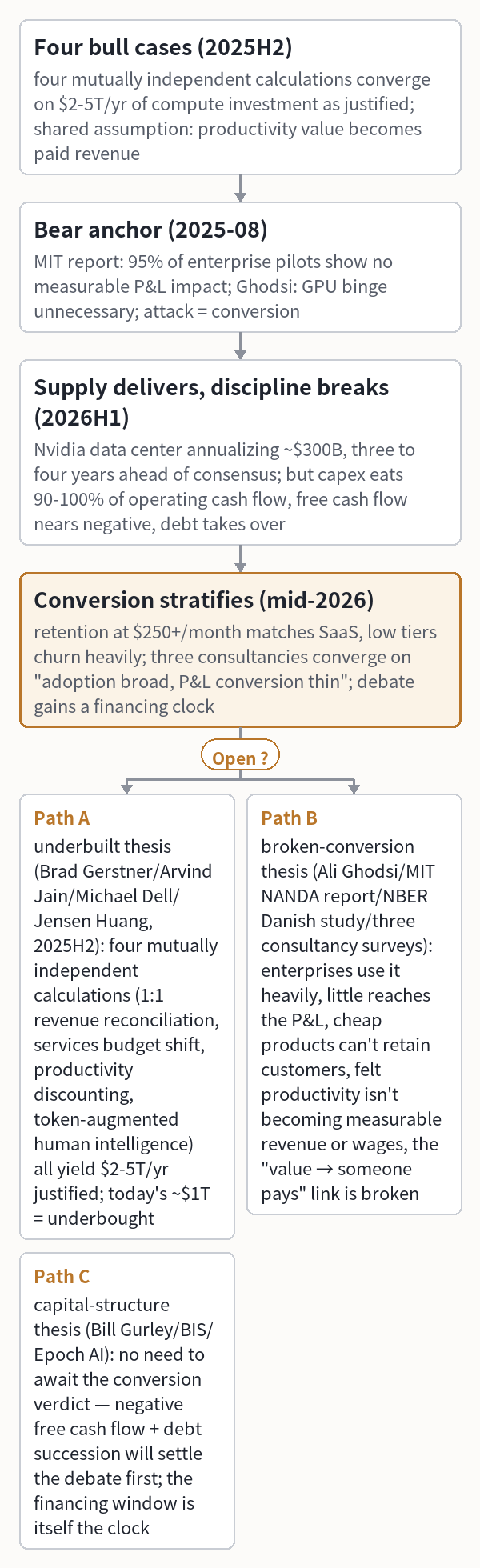
What would prove this wrong: (1) whether net revenue retention for high-tier enterprise tools holds the 85% line (our own observation threshold); (2) once free cash flow hits zero, how fast the spreads and terms the bond market offers deteriorate each quarter; (3) whether any field beyond coding produces a second AI revenue curve solid enough to be reported as its own line item in company financials.
Verdict date: 2027-07-24 (self-set 12-month observation window).
This is the condensed version — the full deep dive goes out tonight at 7:30 PM US Central as a separate email to the same inbox.
Chips & semiconductors
Nothing in last night's scan cleared the bar on the chips and semiconductors side: this batch of 18 pieces ran to models, AI economics, and policy, and the only chip-adjacent material is the GB300 and GB200 rack context in leads 1 and 3. Per our no-padding rule, this section takes the day off.
Product watch
Product-company material from the last 48 hours consists mostly of stubs — incomplete headlines with missing body text — that can't be assessed piece by piece, so this section also takes the day off.
Expert takes
- [This week] (published Jul 23) Wharton professor Ethan Mollick: for using AI to do "real work," there are practically only two options left — and the dividing line isn't the model, it's the scaffolding. Mollick, a professor at Penn's Wharton School and the most widely read AI pragmatist among business audiences, gives a hands-on read for the back half of 2026: for real work, the practical choices are ChatGPT or Claude (from $20/month), and the difference lives in the agent execution environment and product scaffolding, not the models themselves. He sorts each company's products into two types: those that deliver results (the model works in a cloud virtual machine and hands back decks, analyses, and files for your review) and those that show their work (they take over your computer, and you watch them edit files and run commands). His verdict on Google is harsh: it "has fallen behind where it now counts: it has no leading frontier model and it has nothing close to Codex and Code" (Codex is OpenAI's process-visible agent); Chinese open-source models are "surprisingly capable" but take real expertise to use as agents (One Useful Thing, Jul 23). This supports our July 19 call that the valuable position in AI is moving away from the model itself: the model layer went multipolar, but usable agent products did not, and the dividing line has moved to the scaffolding layer. Caveat: this is one person's read; Mollick has early-access relationships with the labs, and he says himself the picture can change at any time.
Research watch (models, academic & technical)
- [This week][Trend] (announced around Jul 22, via relay) A mathematical conjecture that stood for 87 years has been overturned — by an AI paired with human mathematicians. The Jacobian conjecture, posed in 1939, is a famous problem in algebraic geometry. It says that if a polynomial map's "Jacobian determinant" is a nonzero constant, the map should be invertible. An Anthropic researcher announced that, in human-machine collaboration, Claude Fable found a concrete counterexample — the determinant is constant everywhere, yet the map sends distinct points to the same place, directly violating the conjecture. The counterexample was then independently verified by models from rival companies — Moonshot AI's Kimi and OpenAI's ChatGPT — as well as Anthropic's own Sonnet, and multiple counterexamples of the same type followed (theZvi's weekly, Jul 23). Our July 20 issue covered DeepMind's system autonomously solving 9 of 353 open Erdős problems; the evidence quality here is better: the counterexample is mechanically checkable mathematics, and the verification came from competing vendors' models rather than one company's self-report. Three boundaries belong in the record together. The human mathematicians' contribution was substantial — this was not AI working alone. The relayer himself adds a caveat: a problem's being solved also suggests it was comparatively easy. And in the comments, one reader questions whether the counterexample traces back to existing human results in the training data. Attribution and any "first" designation await the academic community. This item, too, is a single weekly relay; we have not obtained the original announcement post. One methodological aside: cross-verification by multiple competing models is worth borrowing for evaluation and acceptance-testing design. No other major new papers this week in the directions we track.
From past insights
A thesis's strongest evidence is also its ceiling: the boundary of "capability is a function of compute budget" (our deep research, July 7, 2026). In early July we consolidated a core thesis: with the right execution environment, a modern model's capability is no longer a fixed property but a function of how much inference compute you're willing to spend. The striking part wasn't the volume of support — it was that the same batch of 40-plus papers both confirmed the thesis and drew its boundary. On the confirming side: capability really does rise with thinking budget, reproducibly across domains. On the boundary side, two representative results: a Princeton team's HAL evaluation ran 21,730 agent tests and found that raising "thinking effort" lowered accuracy in most cases (arXiv, Oct 2025); and the VisualPuzzles benchmark, which deliberately separates reasoning from domain knowledge, found "thinking mode" gains inconsistent across models and tasks — sometimes negative (arXiv, Apr 2025). The mechanism in one line: more thinking doesn't guarantee better; the dividend concentrates in domains where answers can be verified (math, code), and elsewhere the tokens may burn for nothing. How to use it: read with today's lead 2 — the cost-crossover point METR measures is exactly this thesis entering procurement language; but this boundary says to first ask which domain your task lives in before paying for "more thinking."
Sources & accounting
The past 24 hours. Overnight cycle material, 18 pieces: 6 industry newsletters read in full (theZvi's weekly, Exponential View, AINews — two issues (the other), Newcomer, One Useful Thing) plus 12 podcast transcripts processed (2 yielded no signal; those used include the Latent Space Poolside interview). Two more newsletters fetched July 22 were handled in the same pass; one was a pure event announcement with no signal. One X post directly verified this batch: Kratsios's official accusation (primary post); one independent media cross-check (TechCrunch). During the day we closed two directed-verification cases, adding Nvidia's official earnings release and earnings-call transcript — three primary sources in all (results in the last two "Also on the radar" items). No new tracked sources today; no one-off backfills. Coverage statement: this issue can only vouch for signal within the scan described above; 17 product-company official blog posts were fetched this batch, most with headline-only or truncated bodies, and yielded no signal; no full X network scan was run.
A concentration warning. Leads 2 and 4 and the first Research Watch item rely mainly on relays from the same theZvi weekly — close to half of this issue's source material; for lead 2, neither supporting fact has been taken directly from its primary source. The exception is lead 1's accusation: checked directly against the official primary post, with TechCrunch as an independent counterweight. The structural risk — one weekly going dark would wound two leads at once — is something readers should know.
Inventory (not the past 24 hours). Our accumulated reading backlog (backfilled in batches since July; latest snapshot): 2,825 academic papers; 2,299 company and personal blogs; 1,381 X posts; 974 industry newsletters; 924 company filings; 533 industry analyses; 288 podcast transcripts. The long tail beyond today's leads is drawn from here, by topic, on demand.
The sources we track. Beneath this brief's judgments sit 529 named voices currently tracked: 305 on X (Elon Musk, Andrej Karpathy, Greg Brockman, Nathan Lambert, and others), 90 podcast voices (Satya Nadella, Dario Amodei, Jensen Huang, and others), 51 news outlets, 48 personal blogs (Simon Willison, Chris Olah, and others), 48 paper authors (Noam Shazeer, Percy Liang, Tri Dao, and others), 46 newsletters (Dylan Patel, Ben Thompson, Ethan Mollick, and others), 26 companies' earnings and calls, and 23 keynotes.
This is not a news digest: we hunt each day's AI firehose for the insights that actually matter and the practitioner judgments worth tracking over time, and we show how every item was verified — the point is always "which judgment got harder, and who's been right," never "what happened today."
— SecondSource · generated by our research system · 22 sources · replying to this email is the best feedback you can give us
Written from the same research and judgments as the Traditional Chinese edition; every claim links to a primary document.
EN English edition|繁 中文版 Traditional Chinese →