
SecondSource Deep Dive · 2026/7/24|Deep Dive #13 — Four Bull Cases for AI Capex Rest on One Untested Pillar, and the Pillar Just Got a Deadline
In the second half of 2025, four heavyweight figures each ran their own independent math to argue the same conclusion: AI compute is not overbought —
Key takeaways
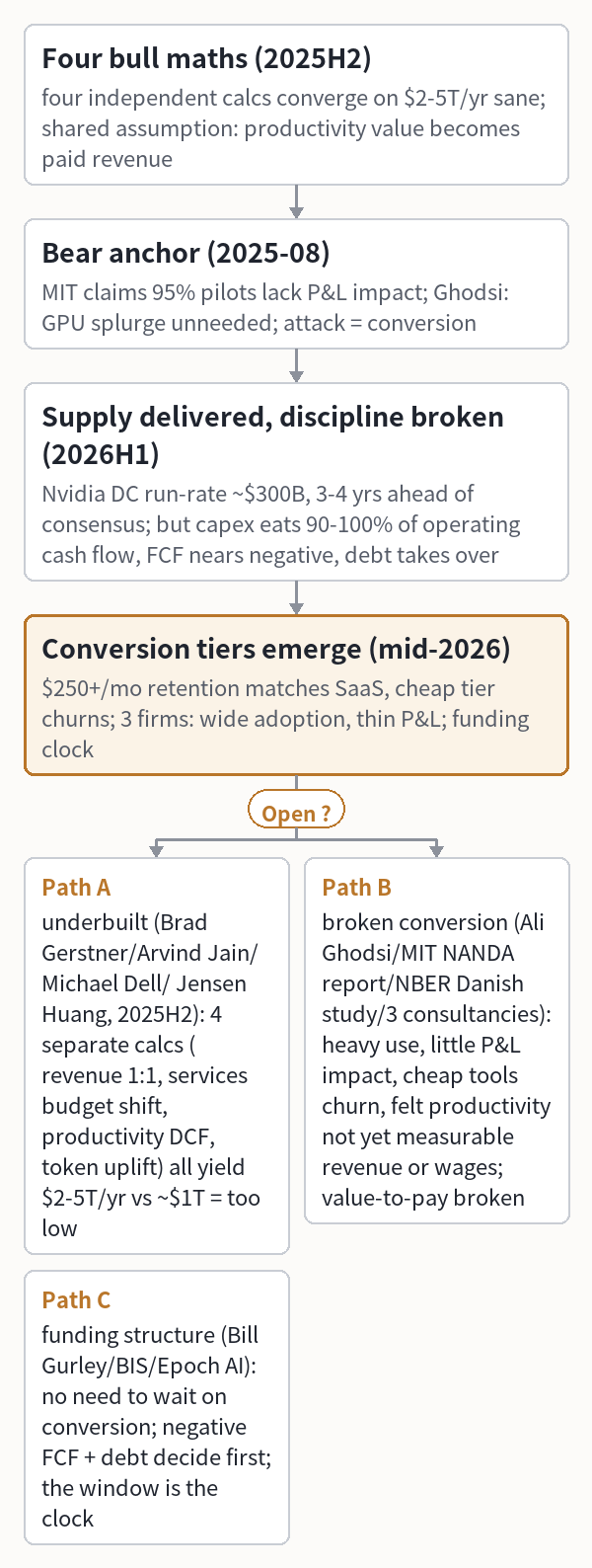
In the second half of 2025, four heavyweight figures each ran their own independent math to argue the same conclusion: AI compute is not overbought — it's underbought. Investor Brad Gerstner used a one-to-one reconciliation of capex against revenue; Arvind Jain, CEO of enterprise-search company Glean, argued AI is raiding a services budget 25 times larger than the software industry; Michael Dell discounted services-sector productivity into dollars; and Nvidia CEO Jensen Huang built gross-margin math on tokens augmenting human intelligence. Four calculations, each independent of the others, converging on the same order of magnitude: a sane annual investment level of $2–5 trillion, against an actual level below $1 trillion at the time. It is the most elegant set of arguments the bull camp has produced, and it is what this piece takes in for inspection. The inspection starts from a structural observation: the four calculations differ in method but share a single load-bearing pillar — the assumption that enterprises will pay something close to full value for productivity gains. The bear case has never attacked the TAM math; it attacks that pillar. By July 2026, the reconciliation splits into three layers. The shovel-selling side has delivered in full — Nvidia's data-center revenue reached, three to four years early, the level Wall Street had penciled in for 2029. The paying side, once unfolded, turns out not to be one number but a curve sorted by price tier: enterprise tools above $250 a month now retain customers as well as traditional software, cheap tools are churning en masse, and only one to two in ten enterprises can trace results to their P&L. And the most consequential new fact is in the structure of the money: big tech's free cash flow is being eaten toward zero by capex, and the buildout is now rolling onto debt. That changes the nature of the debate. "Wait for the conversion data" used to be an open-ended wait; the financing window has now given it a deadline. This piece ends by laying out the two clocks in that race.
Where this debate sits on our map:
Four sets of math at the table, and the pillar they share
Start by laying the four calculations out, because their whole value is that they are mutually independent — independent enough to be graded separately. One honest disclosure first: the only verbatim records of all four arguments come from the same podcast series (BG2 / Altimeter). The speakers are independent of one another; the channel is not.
Gerstner's method is revenue reconciliation. The yardstick he gave in October 2025 is plain: roughly $3 trillion of buildout over the next five years, corresponding to about 60 gigawatts of compute; if OpenAI is to carry roughly $150 billion of annual capex by 2030, it needs at least $150 billion of annual revenue to support it — a dollar of revenue for every dollar of capital spend (BG2 Pod). He also made a falsifiable prediction about financial discipline: big tech's capex as a share of operating cash flow would peak around 66% in 2025, then fall back to 45–50%. Two months later, Jain converted budgets instead. On the same show, the host worked out that industry-wide capex of roughly $500 billion a year needs about $1 trillion of AI revenue to pay off, while the entire software industry books only about $400 billion a year; Jain's answer was that AI is not grabbing the software budget — it is grabbing the services budget, which is 25 times larger, and today's AI spending is, at bottom, services money converting into software money (BG2 Pod / Altimeter). Dell discounted the world economy. If the $114 trillion global economy gets a 10–20% productivity lift overall, that creates roughly $10–20 trillion of value a year, with the services sector — two-thirds of the economy — as the main source of the lift; against that, annual investment ought to run at the $2–4 trillion scale, and today's level sits far below it (BG2 Pod interview with Michael Dell). Huang simply made human intelligence itself the market. His token-augmentation math runs: human intelligence accounts for some 55–65% of world GDP — "let's call it $50 trillion," a round number of his own choosing, not a strict conversion of the 55–65%; if $10 trillion of it gets augmented by AI tokens at 50% gross margins, that requires $5 trillion of AI factories, so — in his words on the pod — "if you told me that on an annual basis the capex of the world was about $5 trillion, I would say the math seems to make sense" (BG2 Pod).
The interest positions behind the four calculations need labeling up front: Dell is one of the largest beneficiaries of AI-server demand, Huang is the largest beneficiary of the entire buildout, Jain sells the very product that would carry the services-to-software conversion, and Gerstner's fund is heavily long the theme. None of that makes the arguments wrong, but it does mean they get graded on a stricter curve than a neutral source would.
Now look at the shared pillar. Every one of the four calculations contains a step that writes "value created" directly into "revenue someone pays": Gerstner's one-to-one assumes revenue will grow up to meet the capex; Jain's conversion thesis assumes services money will actually flow onto AI ledgers; Dell's discounting assumes enterprises will pay something close to $10 trillion for $10 trillion of productivity value; and Huang's 50%-gross-margin step likewise rests on someone buying the $10 trillion of augmented intelligence. Lined up, the four share only this one assumption — and in 2025 there was not a single piece of primary-source measurement behind it. The bear attack lands exactly there: Databricks CEO Ali Ghodsi, speaking to a Stanford MS&E435 class ([Stanford MS&E435 / Ali Ghodsi] (articles/podcast/2026/07/01/msande435-class-04-do-we-already-have-agi-ali-ghodsi-databricks.md), source timestamp July 2026), said that splurging on GPUs is not really what is needed — where enterprises are stuck is getting AI used inside the organization — and cited the MIT report's claim that about 95% of enterprise AI pilots fail, adding himself that the direction is right even if the true number might be 75%. So from day one, this debate was never "whose TAM model is more accurate." It is "what is the conversion rate from value to payment." That is the framework for the verdict, and the next three sections reconcile the accounts one by one: the supply side, the conversion rate, and the structure of the money.
The one-year reconciliation: shovel-sellers delivered in full, discipline died first
The supply side delivered more thoroughly than anyone expected. Nvidia's earnings report in May 2026 showed single-quarter data-center revenue of $75 billion, up 92% year over year and 21% quarter over quarter — a third straight quarter of acceleration (Nvidia earnings); annualized, roughly $300 billion. Compare that with the sell-side consensus Gerstner relayed at the time: about $200 billion in 2025, climbing to $350 billion only by 2029 or 2030. Reality pushed the annualized level to around ninety percent of the consensus 2029 figure by mid-2026, with the latest quarter still growing at ninety percent year over year — though note this describes what has already happened; ninety-percent growth cannot be extrapolated forward in a straight line. On that same pod, Gerstner had put the sell-side consensus to Huang — analysts penciling in just 8% annual growth for Nvidia from 2027 onward — and called it "a massive divergence of belief" between what the builders were saying and what Wall Street believed (BG2 Pod). That round, Huang won. At the GTC conference in March 2026 he raised the revenue opportunity for the Blackwell-and-Vera-Rubin platform generations from the earlier $500 billion to a cumulative $1 trillion through 2027 (CNBC) — with the caveat that this is a cumulative order-opportunity figure, not annual revenue; the two must not be read interchangeably.
But the other column of the same reconciliation shows the bull camp's own financial discipline dying first. Gerstner's most falsifiable prediction — capex peaking at 66% of operating cash flow, then receding — was punched straight through by 2026 reality. Bank of America's estimate (a third-party relay, unverified) is that the five big cloud providers will spend roughly ninety percent of their operating cash flow on capex in 2026, against a ten-year average of about forty percent. The tracking by research group Epoch AI is sharper still: combined cash capex growing about 70% a year against operating cash flow growing about 23%, with the two lines crossing around the third quarter of 2026 — at which point the five firms' combined free cash flow touches zero (Epoch AI, a June 2026 projection). Oracle has already crossed the line: fiscal-2026 capex ran at 174% of operating cash flow, with free cash flow at negative $23.7 billion (Global Datacenter Hub). Gerstner's other yardstick, the OpenAI one-to-one, is just as far out of balance: OpenAI has signed multi-year compute commitments with a nominal total above $1.4 trillion over the past 15 months, against annualized revenue of roughly $25 billion as of April 2026 (tech-insider compilation, third-party estimates, not officially confirmed). Nominal commitments unfold over many years and cannot simply be divided — but even spread out, the distance to one-to-one is still measured in orders of magnitude.
What the authors themselves did next is telling. Gerstner in 2026 remained verbally bullish: the supercycle is still early, the tech giants won't cut AI spending. But his fund liquidated its entire Alphabet position in the first quarter, and the reason he gave publicly was precisely that capex guidance of $175–185 billion had reshaped the free-cash-flow picture; he rotated into ARM, which sells IP licenses and carries no capex. The real motives for the exit may not stop at that one — valuation and competition could both be in the mix — but the reason he chose to give publicly amounts to conceding that the aggregate bull call and single-stock cash-flow discipline are two different things, and that his own 66% discipline line had broken. Dell doubled down instead: at Dell Technologies World in May 2026 he raised his figure to global AI infrastructure spending reaching $3–4 trillion by 2030 (Techgoondu). Jain's company is itself the test article for the services-conversion thesis: Glean's annualized revenue reached roughly $300 million by May 2026, roughly tripling in a bit over a year (third-party compilation, not confirmed by the company) — directionally supportive of his argument, but an absolute value that, set beside $700-billion-plus of annual capex, casts no shadow of a services budget 25 times the size of software. More telling still, in 2026 he shifted Glean's pitch from "helping enterprises put AI to work" toward "cutting enterprises' token bills by thirty percent" — a man whose thesis is budget expansion, selling budget compression.
Supply delivered in full and discipline dead first are both true at once, and they point to the same conclusion: what the supply side's delivery measures is hyperscalers' willingness to spend, not end customers paying for productivity. The purchasing in that middle layer is, at bottom, a bet on downstream conversion placed with other people's money. The pillar is still the same pillar; only the stakes riding on it have grown.
Inspecting the pillar: conversion isn't one number, it's a curve sorted by price
Now test the pillar directly — starting with the flag the bears wave most, MIT's "95% of enterprise AI pilots fail." The original report measures something much narrower than the headline suggests: "failure" is defined as no measurable P&L impact within six months of the pilot; the sample is 300-odd deployment cases, 52 interviews, and 153 questionnaires; the report is self-published and not peer-reviewed. Wharton professor Kevin Werbach said publicly that after reading it several times over he still could not see how the 95% was derived, and called on MIT to release the underlying data or retract (HPCwire coverage); to date there has been no data release and no 2026 follow-up edition. Conclusion: the number can be cited only as one contested signal under a narrow definition, not as hard fact. The bears deserve a harder flag.
Harder evidence exists — and it cuts worse against Dell's productivity discounting. The first block is an academic measurement: two economists wired Denmark's national administrative records to an AI-adoption survey and used econometric methods to track actual income changes in the two years after ChatGPT launched. Their conclusion: income effects above 2% can be ruled out — and that "almost nothing" holds for heavy users, early adopters, employers investing heavily, and workers who self-report enormous gains (NBER working paper w33777). Employees say it helps, employers are spending, and the payroll shows nothing — this is, so far, the hardest primary-source evidence that felt productivity has not become measurable economic output. Its boundaries belong in the same breath: the observation window covers only the first two years after ChatGPT's launch, the sample is one country, and productivity gains have historically lagged for years before showing up — so what the study can say is "hasn't converted yet," not "never will." But note that the lag itself carries a price: the four bull calculations need trillion-scale payment starting to scale now, and every year conversion arrives late is another year on the funding clock in the next section. The second block is that three independent consultancies' surveys converged on the same shape in 2026: MIT says 5% show P&L impact; McKinsey's State of AI survey says 88% of enterprises are using AI but only 6% can attribute more than 5% of pre-tax profit to it; Deloitte's survey of 3,000 executives across 24 countries says 74% want AI-driven revenue growth and only 20% actually see it. The three numbers use different denominators — compare the shape, not the point values — and "can't attribute it" is not "no effect": when gains scatter across departments and systems, accounting was always going to struggle to trace them. But for the pillar this piece is testing, that distinction does not rescue the bulls: value an enterprise cannot measure is value it cannot budget for — measurement friction is itself conversion friction. "Adoption is everywhere, P&L delivery is scarce" is the shape all three agree on, and that is no longer any single report's methodology problem.
Yet in the same year, 2026, the payment data looks entirely different. Real card-swipe data from corporate-card issuer Ramp shows more than half of businesses paying for AI services, with the most aggressive firms spending about $7,500 per employee per month and still growing 14% a month (Ramp AI Index, March 2026); venture firm Menlo's enterprise survey has enterprise generative-AI spending rising from $11.5 billion in 2024 to $37 billion in 2025, with 47% of procurements reaching formal production — nearly twice the go-live rate of traditional software. Note what that measures: the go-live rate of purchases, which is a different metric from this piece's central value-to-payment conversion rate (Menlo Ventures). Can "95% fail" and "47% go live" both be true? Yes — because they measure three different things: one measures P&L impact within six months, one whether something got deployed, and the third whether anyone actually paid. That collision is itself the best evidence for this piece's core judgment: there is not even consensus yet on how to measure the conversion rate, so TAM math was never going to settle anything.
The key that actually resolves the contradiction is cutting retention by price tier. Two terms first: gross retention is the share of customers still paying a year later; net retention adds in existing customers' upsells and price increases, so it typically runs higher than gross — you need both to know whether a product truly sticks. Data from venture firm a16z and subscription-analytics firm ChartMogul draws the same curve: AI-native companies' median gross revenue retention is just 40%, against 63% for B2B software companies in the same sample; but AI products priced above $250 a month post 70% gross retention and 85% net retention — already the level of traditional enterprise software; the $50–249 middle tier drops to 45%; below $50 only 23% remains (a16z and the ChartMogul report). In other words, the conversion rate is not a number — it is a function of price: expensive tools are sticking, cheap tools are leaking. Retention is also improving overall: median gross retention across all AI-native companies climbed from 27% in January 2025 to 40% by September, with the sub-$50 tier still sitting at 23%. Two boundaries on this curve need honest labels. First, the sample is AI-native startups; AI features embedded inside incumbents' existing software are not in it, so the curve does not see the whole enterprise AI market. Second, the high tier's high retention has a self-selection component: buyers willing to pay more than $250 a month were the most certain of their need to begin with, so the number proves "a layer of demand exists that pays and stays" — it cannot be read backwards as "price it high and it will stick." For the pillar under test, the first reading is all we need: the pillar asks whether anyone pays for the value and stays; in this layer, the answer is yes. Turn to the domain where the pillar has already delivered: coding tools are where it has visibly stood up, with official disclosure and retention as two independent legs of evidence. Anthropic's officially announced company-wide annualized revenue reached $47 billion in May 2026 (Simon Willison), and coding tools sit exactly in the high-price, high-retention tier. The product-line split is not official: third-party estimates put Claude Code's annualized revenue climbing from about $2.5 billion in February to about $8 billion in May, with AI coding tool Cursor at about $2 billion (the same product category as Claude Code) — those split figures are directional only, and whether the growth rate holds is unknown. Keep a sense of proportion, too: coding is one domain within enterprise AI spending, not the whole of it; one domain standing up does not generalize to "enterprise AI as a whole stands up." The services domain now has its first audited observation: Accenture's advanced-AI revenue tripled year over year to $2.7 billion in fiscal 2026, with $2.2 billion of new bookings in a single quarter — while the firm cut 21,800 people over two quarters (Accenture earnings). That ledger admits two readings, and both belong on the table: the bull reading is that services contracts are being repriced by AI and the money is switching rails; the bear reading is that substitution is outrunning net creation — AI revenue is not yet growing fast enough to carry the existing headcount, or the layoffs would not be needed. Accenture simultaneously stopped reporting AI metrics as a separate line, with the official reason that AI now permeates eighty percent of its large deals; that cuts both ways too — the penetration may be too deep to unbundle, or the unbundled return numbers may not have looked good. Only one thing is certain: "net-new versus substitution" can no longer be pulled apart from the public accounts.
So the pillar inspection comes down to three sentences. In coding and in enterprise contracts above $250 a month, the pillar stands — the retention numbers are the evidence. In the cheap long tail and in ordinary enterprises' P&L delivery, the pillar is still hollow — the three consultancies' convergence and the Danish payroll data are the evidence. And the four bull calculations need not the first layer but the second, because $2–5 trillion a year cannot ride on coding alone.
A third gambler sits down: the structure of the money puts a clock on the debate
If the story ended at the conversion rate, this would remain a debate that could be waited out forever — bulls saying give it time, diffusion is slow; bears saying we have waited long enough; nobody persuaded. The first two sections already seated two gamblers at the table: the bulls' four maths, and the bears' attack on conversion. What genuinely changed the debate's nature in 2026 is a third gambler sitting down: the source of the money changed.
When the four calculations were made in 2025, they carried an unstated premise: the buildout would be funded from big tech's own cash flow — so even if the thesis proved wrong, shareholders would earn less and nothing systemic would break. That premise broke in 2026. The four big cloud providers' combined 2026 capex is roughly $725 billion, up 77% year over year (that capex total carries no standalone source here; the Yahoo Finance link later in this paragraph covers the bond-issuance numbers, not this one); and as the previous section noted, combined free cash flow touches zero around the third quarter. The gap is being filled with debt: Goldman Sachs estimates AI-related bond issuance of about $489 billion in 2026; large cloud providers' corporate bond issuance jumped from $20 billion in 2025 to $109 billion; Meta issued $30 billion, Amazon about $53 billion, and even cash-rich Nvidia sold its first corporate bond since 2021, at $25 billion (Yahoo Finance compilation). The Bank for International Settlements, in its June 2026 annual report, used language central-bank institutions rarely allow themselves: it warned that if AI investment returns disappoint, financing could be pulled back abruptly, turning this capex boom into a prolonged investment bust, and it singled out circular financing arrangements for poor disclosure of terms and the risk of the same assets being pledged more than once (BIS 2026 annual report). Allianz's research arm measured the divergence: AI capex and revenue growth have now diverged by 46%, wider than the 32% at the peak of the 2001 telecom bubble (Allianz Research).
Put that variable on the table and the structure of the debate changes. The old question — "will the conversion rate eventually vindicate the four maths?" — had no deadline. The new question — "can the conversion rate prove out faster than the financing window tightens?" — has one. Precision matters here: free cash flow touching zero is Epoch's projection, not an accomplished fact; the firm's February projection of first-quarter capex missed by less than 1%, but a projection is still a projection. And even if zero arrives, big tech's credit remains strong — the financing window is not a door that slams shut; it is a set of continuous variables: how much credit spreads widen, and how fast issuance terms deteriorate as multi-year money turns short-dated. So the right way to read the stopwatch is not "the day they can't borrow" but "how much worse the borrowing terms get each quarter." In the era of self-funded cash flow, the conversion answer could wait a decade; in the era of debt-funded buildout, every refinancing is a fresh vote. That is also why this piece treats the money as a third path rather than a footnote to the bear case: its verdict mechanism is fully independent of the conversion rate. Even if conversion ultimately delivers, delivering slower than the bond market's patience still ends in the BIS's investment bust; conversely, if high-tier conversion spreads fast enough, the debt is just a bridge.
The cleanest single signal in this race is the behavior of the bear standard-bearer himself. Through 2026 Ghodsi has kept talking the market down — saying that zero-revenue companies valued in the billions are obviously a bubble, and relaying a Fortune 500 executive's complaint that AI costs were rising exponentially while revenue wasn't keeping up, a path that ends in bankruptcy — while his own Databricks, facing demand strong enough to leave it short of GPUs across Japan, Korea, the US, and India, expanded its fundraising to keep pace (Benzinga, July 2026). That is not self-contradiction; it is keeping two ledgers. Infrastructure demand is real, and the downstream conversion proof has not arrived — both are true at once. And to finish his sentence for him: his bear case has only ever pointed at the superintelligence arms race and at zero-revenue valuations, never at the application layer — and he places his own company in the application layer, so scrambling for GPUs while calling a bubble is, by his own logic, perfectly consistent. Which is exactly this piece's verdict structure: the four bull calculations wrote two ledgers as one, and the strongest form of the bear case has always been about the pace of proof, not whether AI works.
Where we land
The mid-2026 reconciliation of the four bull calculations reads in three layers. The first layer is the supply side, delivered in full. Nvidia's data-center revenue is annualizing at roughly $300 billion, three to four years early against the level sell-side consensus had penciled in for 2029. And in his BG2 Pod exchange with Gerstner, Huang was right to reject Wall Street's forecast of only 8% annual growth for Nvidia; the company kept beating it. But supply-side delivery measures hyperscalers' willingness to spend, not end customers paying for productivity. The second layer is the conversion rate. Unfolded, it is not one number but a curve sorted by price tier. Coding and enterprise tools above $250 a month have stood up: 70% gross retention, 85% net retention, level with traditional enterprise software. The cheap long tail is leaking, at 23–40% gross retention. The band of ordinary enterprises getting results into the P&L is only one to two in ten. And what the $2–5 trillion annual investment case needs is precisely those latter layers. The third layer is the structure of the money, the variable that truly changed the debate's nature. Capex is consuming 90-100% of operating cash flow, combined free cash flow is projected to touch zero around the third quarter of 2026, and debt is taking over. That turns the open-ended "wait for conversion proof" into a race with a deadline: the speed at which high-tier conversion spreads, against the speed at which financing terms tighten. The verdict rides on two clocks: whether the tiered-retention numbers climb or sink, and — once free cash flow touches zero — how much worse the bond market's quarterly terms get.
What this means for you
If you manage a company's AI budget: the tiered retention curve works directly as procurement policy. In the tier above $250 a month, your peers' renewal behavior already matches traditional enterprise software — that tier is worth multi-year contracts in exchange for discounts. Treat sub-$50 tools as consumables: review quarterly, cut freely — though don't over-read the churn in that tier either; cheap tools get rotated like trial goods by design, and the churn is partly a usage pattern, not simply product failure. When grading your own AI investments, remember the peer waterline: one to two in ten enterprises get results into the P&L. Beat that and you're ahead; missing it isn't failure — but if six months pass with no measurable indicator at all, you are inside MIT's 95%, and what needs cutting is the project design, not the budget.
If you allocate capital: stop waiting for a better TAM model — the four calculations never disagreed on the model; they share the same pillar, and the pillar has exactly two acceptance indicators: whether high-tier net retention holds the 85% waterline (a threshold this publication set for its own observation, not a line drawn by an outside authority), and what spread the bond market demands once free cash flow touches zero. Gerstner himself demonstrated how to stay bullish on the aggregate while managing single-stock risk: his stated reason for exiting Alphabet was not disbelief in AI but capex guidance reshaping free cash flow — the aggregate bull call and single-stock cash-flow discipline can, and should, be run separately. And mark the third quarter of 2026 in your calendar: that is the quarter Epoch projects combined free cash flow touching zero, and every bond issuance's terms after that are this race's live scoreboard.
If you sell an AI product: the tiered curve is a product-strategy map, but read the direction correctly: it is not that raising prices earns retention; it is that workflow integration deep enough to justify $250 a month earns that tier's retention, with price following as a result rather than acting as the lever. Stay below $50 and your product is, in the data, a consumable: 23% gross retention supports no long-term contract. The bigger prize is the second revenue curve: in this entire debate, coding is the only domain with hard delivered numbers. Whoever produces standalone, company-filings-grade AI revenue in customer service, legal, advertising — any one domain — will have delivered the first AI revenue curve of that grade beyond coding, and the next hard number this debate can reconcile against.
The updated map after this piece (this piece planted the tree; the three-path tiered verdict is written into its nodes):
Written from the same research and judgments as the Traditional Chinese edition; every claim links to a primary document.
EN English edition|繁 中文版 Traditional Chinese →