SecondSource Product · 2026/8/10|Ten days to the enterprise cloud
On July 27, Beijing-based Moonshot AI put the full weights of Kimi K3 — a 2.8-trillion-parameter model, 1.56TB on disk — on Hugging Face for anyone
The 30-second version
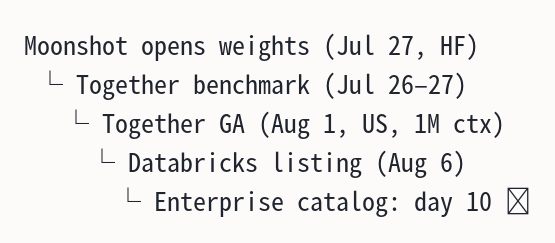
On July 27, Beijing-based Moonshot AI put the full weights of Kimi K3 — a 2.8-trillion-parameter model, 1.56TB on disk — on Hugging Face for anyone to download. Ten days later, on August 6, that same model was live on Databricks with full enterprise governance, sitting in the same dropdown as the closed models from Anthropic, OpenAI, and Google. In between, Together AI published two posts: one benchmarking K3 head-to-head against OpenAI's GPT-5.6 Sol, the other showing developers how to run it at its full one-million-token context window on US infrastructure.
The speed is the story. A frontier-class open-weight model went from public weights to a governed procurement catalog on a Western enterprise cloud in ten days. If you own an AI budget or a model strategy, the takeaway is not "another strong Chinese model." It is this: model procurement is shifting from picking a vendor to managing a portfolio — and open weights just pulled the cheapest slot in that portfolio up to frontier quality.
The chain of events
July 27 — weights go public. Moonshot released the complete Kimi K3 weights on Hugging Face: 2.8T total parameters, 104B active per token, a 1M-token context window, natively multimodal. The model card calls it "the world's first open 3T-class model" (HF model card). Simon Willison, an independent observer, logged the release the same day: 1.56TB of weight files, and a license that is not open source. The license text is explicit — "If the Licensee or any of its affiliates operates a Model as a Service business, and the aggregate revenue…exceeds 20 million US dollars…the Licensee must enter into a separate agreement with Moonshot AI." He also credited Moonshot for honesty: their materials consistently say open weight, never open source (simonwillison.net).
July 26, the eve of the release — Together fires first. Together AI published a 904-run comparison pitting K3 (then only reachable through Moonshot's own API) against GPT-5.6 Sol. Single attempt: Sol wins, 72.7% to 68.5%. Four attempts: K3 pulls ahead, 89.4% to 85.8% — at $4.65 per run versus $8.37. The report's real conclusion is not who wins. It is that the two models fail in different places, so a routing strategy — run the cheap model first, escalate on failure — beats either model alone: "a Kimi-first cascade that escalates to Sol covers 108 of 113 tasks and reaches about 85.6%" (Together blog). Caveat: Together ran the test, and Together sells multi-model routing infrastructure. We take the direction, not the decimals.
August 1 — Together goes GA. Developer guide published: US-hosted, full 1M-token context, OpenAI-compatible API. Pricing in three tiers: $0.30 per million input tokens on cache hit, $3 on miss, $15 for output (Together guide) — consistent with the $3/$15 pricing Willison recorded across seven OpenRouter providers.
August 6 — Databricks lists K3, governance included. Databricks announced K3 in its Foundation Model API: hosted by Databricks in the US, zero data retention, governed through Unity AI Gateway — permissions, audit, budget controls, identical to the closed models on the platform. Their words: "By offering native access to Kimi K3, together with top proprietary models from Anthropic, OpenAI and Google Gemini customers have maximum choice and control." Databricks also claims K3 ran at "50–72% lower cost-per-task than comparable proprietary models" in internal enterprise tests (Databricks blog). That cost figure is a single-source vendor claim with no published methodology.
Whose decision does this change
- Enterprise AI platform owners: the unit of model strategy just changed. Governance used to be the closed-API vendors' implicit pitch — you were buying compliance, audit, and SLAs. Databricks just demonstrated that a platform can supply all of that as a service, in double-digit days. One receipt for the trend line: DeepSeek-R1 took 49 days from public weights to fully managed on AWS Bedrock (AWS announcement); K3 cleared the same governance bar in 10. The decision to make: before your next contract renewal, put portfolio-plus-routing on the evaluation list and benchmark an open-weight option on your own workload.
- Legal and procurement: "open" is not a conclusion. K3's license is not MIT. Model-as-a-service businesses above $20M in annual revenue need a separate agreement with Moonshot. The decision to make: read the license text before self-hosting or reselling, and put that threshold into your procurement checklist.
- Account teams at closed-model vendors: your competitor changed. Three independent sources point the same direction — frontier-class quality now has a roughly half-price option, running on the customer's cloud of choice — and Together and Databricks are both teaching customers to run cheap-first, escalate-on-failure. The decision to make: rewrite the value proposition. You are no longer competing against another lab; you are competing against a portfolio of your own model plus half-price open weights, and the margin on pure API resale is compressing.
What we don't know
- Together's benchmark is single-source. 904 runs, run by Together, whose business is multi-model routing. Direction credible — slightly weaker single-shot, ahead on retries, roughly half the cost — but no independent replication of the exact percentages.
- Databricks' cost claim is equally single-source, with no methodology or comparison pricing published. Databricks has not published K3's actual API price; we won't guess it.
- Moonshot's training cost, compute sources, and training data: undisclosed.
- Adoption is unknown. A catalog listing is not usage. Hugging Face shows ~1.39M downloads last month — a platform counter that includes automated pulls. There is no verifiable number for Western enterprise production deployments.
- Geography. Databricks and Together both host in the US only for now; on Azure, Databricks routes through ADI rather than native hosting. Compliance paths for Europe and elsewhere remain open questions.
Web archive: https://secondsource.io/en/p/product-2026-08-10-ten-days-enterprise/
SecondSource publishes industry analysis, not investment advice. We do not evaluate, rate, or recommend any specific security, and nothing here should be treated as financial guidance — verify independently and use your own judgment.
EN English edition|繁 中文版 Traditional Chinese →