
SecondSource Deep Dive · 2026/7/21|Deep Dive #11 — They Stopped Buying: Four Years of Chip Controls Built a China That Rejects American Chips
This is the story of a policy completing a full circle. In October 2022, Washington imposed export controls on China with one goal: choke off the
In brief
This is the story of a policy completing a full circle. In October 2022, Washington imposed export controls on China with one goal: choke off the compute China needed to build frontier AI. Four years later, the control regime has mutated into "you may buy, and the US government takes 25%" — and Beijing's answer is: we're not buying. NVIDIA CEO Jensen Huang himself says the company's share of China's AI chip market has gone from above 90% to zero; White House AI czar David Sacks conceded last December that China's rejection of the H200 had outfoxed the American strategy. The debate used to be framed as "are the controls working?" — one side says the gap is real and measurable (Chinese models trail American ones by an average of seven months); the other says the controls are catalyzing a fully self-sufficient Chinese stack running from chips through memory to design software. This essay lays out both sides' evidence side by side. Our judgment: both are right on their own clocks — but a new fact in 2026 has changed the question. China has internalized the embargo as its own policy: one track still points at the American chip market, the other is a Chinese-built, fully self-supplied stack, and this dual-tracking no longer needs American controls to sustain it. What now decides the quality of that self-supplied stack is a single bottleneck called high-bandwidth memory — and the company holding that bottleneck lists in Shanghai six days from now.
Where this debate sits on our map:
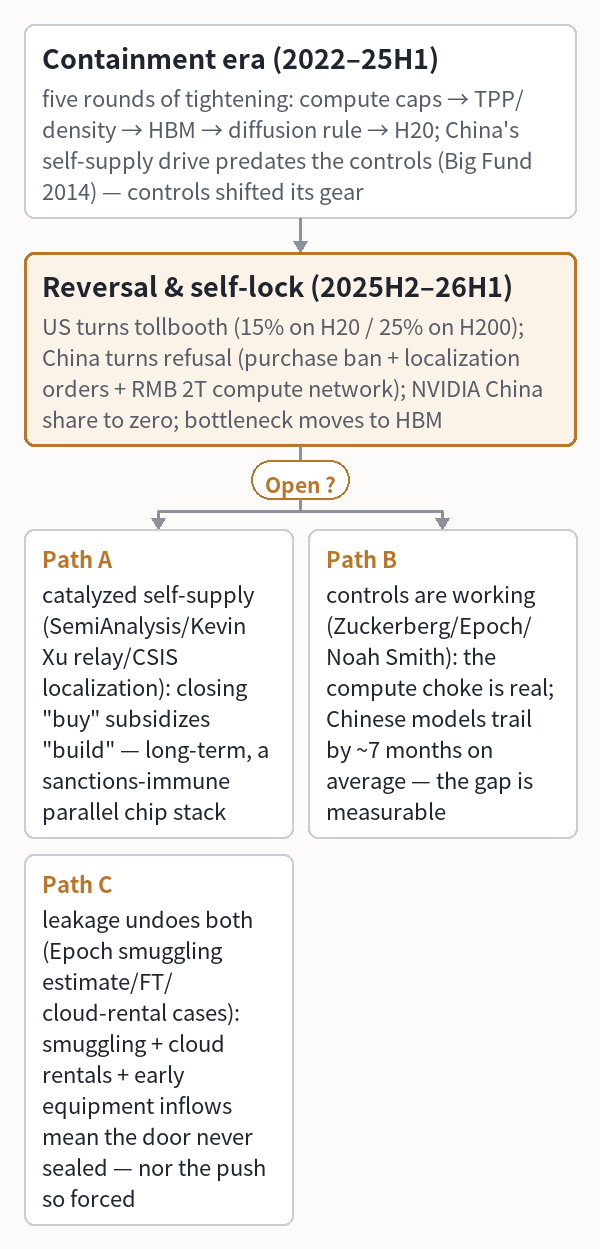
First, the timeline: five rounds of tightening, two hairpin turns
To judge whether the controls worked, you first have to pin down what they actually controlled — because the regime changed at least seven times in four years, and twice reversed direction outright.
The five rounds of tightening: October 2022, round one, covering advanced computing chips (catching the A100 and H100) and semiconductor manufacturing equipment. October 2023 added a dual threshold of "total processing performance" and performance density, closing the door on the H800 and A800 — the down-specced parts NVIDIA had designed specifically for China (the threshold numbers: TPP 4800, density 5.92; see CSET's explainer of the rules). December 2024 reached into high-bandwidth memory (HBM) and put 140 Chinese and China-adjacent entities on the restricted list (CSIS). January 2025 brought the outgoing Biden administration's AI diffusion rule, sorting the entire world into three tiers. And in April 2025, even the down-specced H20 was pulled under license requirements — NVIDIA booked a $5.5 billion inventory charge (NVIDIA 8-K).
Then, two hairpin turns. First: in May 2025 the Trump administration rescinded the diffusion rule (BIS press release), and in August restored H20 sales to China — on the condition that NVIDIA and AMD remit 15% of their China revenue to the US government (Fortune). The second turn was bigger: from January 15, 2026, H200-class chip exports to China moved from "presumption of denial" to case-by-case review, priced at a 25% ad valorem cut (Mayer Brown's regulatory summary). In four years, the regime went from containment to tollbooth. Top-of-the-line Blackwell remains fully banned, but the second flagship now has a posted price.
How much has the tollbooth collected in its first six months? Under Secretary of Commerce Kessler testified before Congress on July 14: actual shipments have been negligible — "Very small quantity of chips, so it's trivial" (TechTimes, citing the hearing). Licenses worth an estimated $10 billion have been approved; transactions have converged on zero. Why? Because the other side closed the road. That is the protagonist of this essay's second half — hold that thought.
The timeline itself is the foundation of the first judgment: "did the controls work" is not one question — it is at least three. Did they open a compute gap (next section)? Did they catalyze Chinese self-sufficiency (the section after)? And how much of it leaked through (the fourth section)? The three questions keep different ledgers. Their answers cannot refute each other; each has to be measured on its own.
The case that the controls are working: the gap is real, and you can measure it
Start with the first ledger.
What it claims. The mechanism chain is direct: frontier AI capability correlates strongly with training compute; choke the compute supply, and Chinese model capability falls systematically behind. The lag need not be permanent — it only needs to hold long enough for America to round the corner first using the lead window.
Who's betting on it. Mark Zuckerberg, in an April 2025 interview, said of the chip restrictions that "you can see how they're clearly working in a way" — DeepSeek, in his telling, "basically had to spend a bunch of their calories and time doing low-level infrastructure optimizations that the American labs didn't have to do" because it was stuck with the nerfed chips NVIDIA was allowed to sell into China, which is also why DeepSeek stayed text-only while every new major model went multimodal (Dwarkesh Podcast). On the analyst side, the standard-bearers are Epoch AI and the economics commentator Noah Smith, whose January summary was that the controls are doing exactly what they were designed to do — not killing China's chip industry, but slowing it down at the critical points (Noahpinion).
How hard the evidence is. This side owns the hardest numbers in the debate. On the capability gap: Epoch AI's measurement published in January (covering through the end of 2025) put Chinese models an average of seven months behind American ones, with a range of 4 to 14 months; as of that measurement, no Chinese model had exceeded the capability index of o3, the model OpenAI released in April 2025 (Epoch AI). That is a snapshot, not a constant. Recorded Future, using a different method, estimated three to six months; the only thing the two estimates agree on is that the gap exists and is measured in months, not years (the two measurements are not fully aligned on timing or method — the difference may come from when they measured rather than from methodological disagreement). On the compute gap: of 130 language models released between 2017 and 2024, more than nine in ten were trained on Western hardware (Epoch AI). The think tank IFP estimates that in a hypothetical with no exports and no smuggling, America's advantage in newly added AI compute in 2026 would run 21 to 49 times China's, and that opening H200 exports would compress it below 6.7x. We have that figure only secondhand, relayed by Noah Smith (we could not locate IFP's original page), and its no-smuggling premise collides with the denominator evidence in the fourth section; we use it as a scenario ceiling, not a quantitative pillar. On behavior: DeepSeek's R2 was delayed by the H20 shortage (Tom's Hardware); Alibaba's Qwen and ByteDance's Doubao teams have been reported to move part of their training to overseas clusters; and ByteDance, Alibaba, and Tencent once threw $16 billion at hoarding 1.3 to 1.6 million H20s (Tom's Hardware). Voting with their feet — NVIDIA silicon is still the hard currency. And on the supply-side ceiling: the choke point of Huawei's own chips is HBM. SemiAnalysis estimates that without stockpiles, domestic HBM capacity caps China below 300,000 units of the 910C per year (relayed via Tom's Hardware) — against NVIDIA's annual shipments measured in the millions.
Where it's weak. First, "working" here means a gap, not prevention. Seven months of capability lag is what four years of controls — and tens of billions of dollars of NVIDIA's foregone China revenue — bought. Whether that was a good trade depends entirely on what you believe seven months can be converted into. Second, the lag measurement itself is contested: Recorded Future says three to six months, and the speed at which Chinese models close the distance after each US release is increasing. Third, and most telling: by 2026, nobody in the executive branch still says "the controls are working." We searched the public English-language testimony and press releases of BIS, Commerce, and White House officials from 2026 onward and could not find a single clean declaration of victory (Chinese state media excluded); the official posture is now "stronger enforcement" running in parallel with "open for a fee." Today, the effectiveness case is carried mainly by analysts and congressional hawks. A policy that needs continuous enforcement escalation — and opened a tollbooth — has an "effective" that at minimum belongs in quotation marks.
What would prove this wrong. The capability gap narrowing inside Epoch's lower bound of four months; or a Chinese frontier lab publicly completing a full flagship-model training run on domestic silicon. By frontier lab we mean a research organization at the leading edge of AI capability — the OpenAI and Anthropic class — not Huawei training its own models. Either event would mean the compute choke point is no longer a choke point.
The case that the controls raised a rival: three fronts, and one harder piece of evidence
Now the second ledger — what the controls did to China's incentive to build.
What it claims. Not "China is progressing fast." Something more precise: the controls removed "buy" from the menu, which is functionally an open-ended subsidy voucher for "build." Domestic alternatives that could never beat the CUDA ecosystem on commercial terms suddenly had a guaranteed floor market. Our own earlier work flagged this pattern and named it the hardware version of the export-control paradox: a short-term American lead that may incubate, over the long term, a parallel chip stack immune to sanctions.
Who's betting on it. The lineage is wide. On the analyst side, SemiAnalysis's Dylan Patel has argued since 2024 that incremental tightening is the worst of all options — his analogy is a jigsaw puzzle: take away one piece and the kid still finishes it; take away ten and it gets much harder — so either seal the door completely or let go, because removing one piece at a time just teaches China to solve each missing piece in turn (ChinaTalk). On Lex Fridman's podcast he put it more starkly: if AI does not deliver transformative results in the short run, export controls all but guarantee that China wins in the long run (interview transcript). The tech-and-China observer Kevin Xu's version (as relayed by Interconnects) is the crutch theory: NVIDIA chips are China's crutch, and nobody learns to run while leaning on a crutch — cut it away and you hand America a short-term lead while forcing China onto a more formidable long-term trajectory. On the think-tank side, CSIS's industrial-policy team wrote in March that the controls have clearly accelerated Beijing's long-standing drive for semiconductor self-reliance (CSIS). Even the counterparty has endorsed the thesis: Huawei's chairman publicly thanked American controls for pushing Chinese firms to build their own technology stack (Tom's Hardware).
How hard the evidence is: three fronts. The compute layer: Huawei fully open-sourced CANN, its CUDA counterpart, in August 2025 (Global Times); when DeepSeek V4 shipped this June, CANN was one of only two software stacks in the world that could run it on day zero — the other being CUDA itself; AMD did not make the cut (SemiAnalysis's exact words: "The Huawei CANN stack is one of only two stacks with Day 0 Support for DeepSeekV4" — InferenceX). That covers inference. Training is no longer zero either, but the boundary needs marking: Huawei has publicly trained a 135B dense model on 8,192 Ascend chips, and trained Pangu Ultra — a 718B mixture-of-experts (MoE) model — on Ascend clusters (arXiv), using its own MindSpore training framework on its own models. "Huawei can train its own models on its own chips" is now established; "a Chinese frontier lab trained a flagship on domestic silicon" still has not happened. The 910C's shipment target is roughly 600,000 units this year, with next year's product line reaching for 1.6 million dies. The memory layer: Chinese DRAM maker CXMT's share of global DRAM bit shipments climbed from 3% to 8% in a single year (the scope is the whole DRAM market, mostly conventional memory; of its 265,000 wafer-per-month capacity, less than 2% is allocated to HBM — SemiAnalysis); its Q1 revenue rose sevenfold year over year; and on July 27 — six days from now — it lists in Shanghai at a valuation of roughly RMB 580 billion, the largest semiconductor IPO in the history of China's A-share market (TechNode). The design-tools layer: the three big American EDA vendors still hold about 80% of the Chinese market, but the domestic share is rising — and the EDA cutoff of May 2025 lasted exactly six weeks before being reversed under rare-earth counter-pressure (CNBC). The chokehold got choked back, for the first time.
But the hardest evidence is not progress numbers — it is Beijing's behavior. Progress can be exaggerated; purchase orders do not lie. In September 2025, China's cyberspace regulator ordered the big tech companies to stop buying NVIDIA's China-specific chips. From August 2025, public data centers were required to run majority-domestic chips; from November, state-funded projects excluded foreign accelerators entirely — facilities less than 30% complete were ordered to rip out NVIDIA hardware already installed. And this June, Beijing launched a five-year, RMB 2 trillion national compute network program that mandates at least 80% domestic technology, AI chips included (Bloomberg's original reporting, relayed by TechTimes). This is the strongest signal type in the game: not propaganda, but revealed preference — giving up the better short-term product in order to feed your own supply chain. Huawei founder Ren Zhengfei's internal target has reportedly reached 70% full-chain self-sufficiency by 2028, though we have not located an independent primary source for that figure; treat the sentence as unconfirmed.
Where it's weak: the catalysis attribution needs a haircut. The easiest mistake this camp makes is crediting every Chinese advance to the controls. The timeline refuses to cooperate: the national Big Fund was established in 2014 (first tranche: RMB 138.7 billion); the 70% self-sufficiency target of "Made in China 2025" was written down in 2015; CXMT and Yangtze Memory (YMTC), China's main NAND-flash maker, were both founded in 2016; SMIC's 7nm process was teardown-confirmed in production before the 2022 controls. Chip historian Chris Miller's reminder is blunt: the Chinese government has been determined to build its own chip ecosystem, and has been at it for more than a decade (WGBH interview) — attributing the goal to the controls gets the sequence backwards. CSIS's Gregory Allen goes further still, arguing it is entirely possible that without the export controls, China would already be ahead of the United States in AI (CSIS) — because DeepSeek founder Liang Wenfeng, as relayed from his interviews, has said that money was never the problem; the embargo was. So the accurate version of the catalysis thesis is not "the controls lit the fire" but "the fire was already burning — the controls shifted its gear": Huawei's official rationale for open-sourcing CANN was precisely that CUDA chips could no longer get in, and the regulator dared to issue its purchase ban only because domestic substitutes had finally become usable. The timing and the resource flows of those two steps did change because of the controls. The other weakness is quality. Every layer of the self-supplied stack still has an unfilled gap: SMIC's advanced-node yields are estimated below 50%, with 5nm still in pilot; CXMT's cost per bit runs more than 30% above the big three memory makers; and at the stack's throat, HBM, domestic capacity is a hard ceiling through 2027 — the wall arrives the moment Huawei burns through its hoard of 13 million Samsung HBM stacks (AI Frontiers).
What would prove this wrong. Two directions. If CXMT's HBM3 yield fails to climb, the hoard runs dry around 2027, and domestic cluster installations stall, then "self-sufficient stack" demotes to "inference-only side stack." Conversely, if Beijing's purchase ban softens and Chinese clouds resume buying NVIDIA at scale, the revealed-preference evidence chain snaps. Both sit on our watchlist (the window is 12 months, set by this publication itself, to be reviewed at expiry).
The denominator neither side counts: the compute that leaked
The two cases above share one silent assumption: that the door actually closed. The denominator evidence says: the door closed; the window stayed open the whole time.
The smuggling is not a rounding error. Epoch AI's multi-source cross-estimate puts cumulative smuggled compute into China at a median of 660,000 H100-equivalents, with a 90% confidence interval of 290,000 to 1.6 million. The Financial Times, after reviewing contracts, estimated that more than $1 billion of NVIDIA chips entered China in May–July 2025 alone, with full B200 racks openly offered on the black market at a 50% premium (CNBC's account of the FT reporting). The cloud loophole requires no smuggling at all: media reports describe a Chinese company renting 2,300 banned Blackwell GPUs through an Indonesian data center, and Tencent signing a $1.2 billion Blackwell compute contract through a Japanese intermediary (Tom's Hardware; both cases are media accounts without official enforcement records — we treat them as evidence that the channel exists, not as volume estimates). The House passed a bill 369 to 22 in January to extend export controls to cloud rental for the first time; the Senate's intentions are unclear. Equipment leakage, meanwhile, is narrowing: China once accounted for 48% of ASML's system sales; in the latest quarter (Q1 2026) that fell to 19%. That is the comedown after a three-year buying spree — the equipment is already inside China's fabs.
The denominator's damage is symmetric. To the effectiveness case: the 21–49x compute advantage is a paper number from a no-smuggling scenario, and the real gap has had a slice eaten out of it by smuggling and cloud rental — compute-governance researcher Lennart Heim has gone as far as identifying a Chinese data center that appears to have run pretraining on the order of 10^19 floating-point operations on domestic clusters suspected of using smuggled components. To the catalysis case: if China could always top up on NVIDIA compute through the side door, the "forced up the mountain" narrative takes the same haircut — the climb was more voluntary than it looks. The denominator does not adjudicate the debate. It pulls both sides' numbers toward the middle.
The tollbooth opened, and the other side closed the road: three ledgers on one table
Now assemble the pieces. Through the controls' first phase (2022 to mid-2025), both cases are right on their own ledgers: the compute gap is real (the effectiveness ledger), all three fronts of the self-supplied stack accelerated (the catalysis ledger), and leakage discounts both (the denominator ledger). What actually changed the question is the game reversal that began in late 2025. The most basic lesson of strategic analysis applies here: you do not judge a policy by its effect on the opponent's first move — you judge it by whether the opponent's response takes away the policy's grip.
The sequence of the reversal rewards a step-by-step read. America moved first: 15% on the H20, 25% on the H200, on the logic of Sacks's diffusion doctrine — better to keep China hooked on the American technology stack than to hand Huawei a protected home market from which to grow globally competitive (as reported by the Taipei Times). Beijing moved next: the regulator's purchase ban, customs enforcement, escalating localization orders — turning America's tollbooth into an empty booth. By December, Sacks himself was conceding on Bloomberg — "outfoxing US strategy," as the headline put it — that China was rejecting the H200 because it no longer needs American chips: it is producing its own, and intends to compete in the global semiconductor market (Bloomberg). Huang supplied the closing number: NVIDIA's share of China's AI chip market has fallen from above 90% to zero (Tom's Hardware). That sentence comes from a man with every incentive to overstate the loss while lobbying for relief — but NVIDIA's own filings corroborate it at the audit layer: China data-center Hopper shipments at zero, China excluded from guidance.
The implication runs past "the paradox came true": the last lesson the controls taught China was how to internalize them. In 2022, Washington would not let China buy. In 2026, Beijing will not let China buy. Once the embargo's enforcer switches from the controlling side to the controlled side, the dual-tracking no longer depends on American policy's will to sustain it. America now wants to sell — and cannot get in. The condition on this judgment has to be stated honestly: the $10 billion in approved licenses is still sitting there, and if the purchase ban softens inside some grand bargain, the transactions can close at any moment. So the precise form of "irreversible" is: the hand throttling the flow today is Beijing's, and whether Beijing loosens that hand is this essay's number-one watch variable. This also resolves the oddity from the opening: tollbooth revenue converging on zero. One aside: the control machine has begun to feel the bite of the shortage it helped create — in June, BIS was reported to have paused adding CXMT and roughly a hundred Chinese firms to the entity list, citing the operational strain on American companies amid the memory shortage. The controlling hand, restrained for the first time by the industry it was built to protect.
So what will the self-supplied stack grow into? Judge it at the narrowest point. Wafers are moving: SMIC's 7nm capacity doubles next year. Design is moving as well, now that the CANN ecosystem has a guaranteed floor market beneath it. Models are moving too: Kimi K3, the latest model from Chinese AI lab Moonshot AI, released last week, lists another vendor's GPGPU in its chip field — without even bothering to name NVIDIA (we have not yet located the public release page carrying this field description; listed as pending verification). That detail suggests the domestic stack may be more than a single Huawei line, and it is queued for our next research round. Only HBM is the hard wall. The hoard is countable: roughly 13 million Samsung parts, which by AI Frontiers' conversion is enough for about 1.6 million 910Cs, coincidentally the same order as next year's ~1.6 million-die production target. That conversion embeds assumptions about per-chip memory configuration; if domestic HBM covers the inference side while imported parts are reserved for training, the exhaustion date stretches out. The cash-in date for domestic substitution rides entirely on CXMT's HBM3 yield. So this essay's directional judgment closes on a race between two clocks — not the familiar race of whose chip commoditizes faster or whose ecosystem locks customers in tighter, but this one: the burn-down speed of China's hoarded memory, against the climb rate of CXMT's yield. If the climb wins, then around 2028 the world will hold two mutually insulated AI hardware supply chains. If the hoard burns out first, China's AI stack hits a wall it cannot yet build its own way through in 2027 — and whether Beijing can still stomach its own purchase ban at that moment is the ultimate test of the word "self-sufficient."
Where we land
"Are the controls working" is an obsolete question in 2026. On the compute-gap ledger, they worked: Chinese models trail American ones by an average of seven months. On the catalysis ledger, they backfired: all three fronts of the self-supplied stack accelerated, and China has taken over the dual-tracking with an embargo of its own. On the leakage ledger, both sides' numbers take a haircut. The genuinely new fact is that the controls taught China to internalize them: the embargo's enforcer has switched from Washington to Beijing, and the dual track no longer needs American policy to sustain it. Over the next year, what decides the quality of the self-supplied stack is the race between two clocks: the burn-down speed of China's hoarded HBM, against the climb rate of CXMT's memory yield.
What this means for you
For decision-makers at American clouds and model companies: China-market zero has moved from a risk to a settled fact. What deserves watching now is the spillover: once a sanctions-immune parallel supply chain firms up around 2028, its next stop is sovereign AI contracts across the Global South, and the combination of Huawei chips plus open-source models becomes your actual competitor in third markets — when you price those bids, remember the rival's cost structure has no NVIDIA tax inside it. The near-term signal to watch: whether that combination makes the shortlist the next time a Global South sovereign-compute tender opens.
For operators in the chip and memory supply chain — which dashboard matters? The most valuable thing in this race is not GPUs; it is memory. CXMT's HBM3 yield and expansion pace (disclosure obligations increase after the July 27 listing) are the single best indicator for dating China's self-supplied stack. And remember that the 13 million already-sold Samsung HBM stacks are counting down inside Chinese warehouses: the quarter they run out, the global memory supply-demand balance reshuffles.
For people in policy seats, write down the uncomfortable lesson first. A control regime's success criterion has to include the adversary's response function: four years and five rounds of tightening ended with the adversary copying your policy and enforcing it themselves. Looking forward, the actionable levers have moved from "whether to sell chips" to "whether to rent cloud" (the House bill's fate in the Senate deserves watching) and to HBM's upstream inputs and equipment. And any sell-chips-to-create-dependence strategy must first answer the question Sacks never did: what do you do when the other side stops taking your calls?
Written from the same research and judgments as the Traditional Chinese edition; every claim links to a primary document.
EN English edition|繁 中文版 Traditional Chinese →