
SecondSource Daily Brief · July 19, 2026 | Four Insiders Who've Never Met Just Pointed to the Same Conclusion: The Value in AI Is Moving Away From the Model Itself
At a glance
- A researcher, an analyst, and two startup CEOs — none citing the others — pointed in the same direction this week: cheap, good-enough open models will squeeze profit away from selling models and toward selling compute, workflows, and devices. All four are still single-source judgments, but four of them landing at once is itself the signal.
- A US health insurer let an AI employee (an agent) running on Anthropic's models handle medical-provider contracting end to end, from researching the counterparty to executing legally binding contracts. The CEO self-reports per-contract cost falling from roughly $1,500–2,000 to roughly $70, and says the economics would survive even a fivefold model price hike. His vendor can hear that, too.
- Databricks, the data-and-AI platform company, officially announced it is raising at a $188B valuation — five months after being valued at $134B. Private markets keep paying up for companies that hold positions, and this round's money is explicitly earmarked for AI acquisitions and agent products.
Sourcing for this issue: the July 19, 2026 research daily brief; the material mostly covers events from July 18, plus four early-July podcast interviews that reached us in this batch — each item carries its event date. We scanned 155 new items overnight; this issue includes 19 linked pieces of evidence. Concentration disclosed up front: five of the interview transcripts come from a single podcast, The Cognitive Revolution (Nathan Labenz's long-form AI interview show). The five guests are unrelated to one another, but the selection runs through one host; each item is flagged, and items from the same source are never used to corroborate one another. Separately, today's story 3 (the Sacks regulation debate) and story 5 (Chamath's infrastructure numbers) draw on the same July 18 episode of All-In — not two independent sources — and are flagged as such in each item.
Today's main stories
1. [Today] Once open models close in on the frontier, where does the money go? Four independent answers surfaced this week, all pointing the same way. Our July 17 issue covered the event: Kimi K3, the open-weight model from Chinese AI company Moonshot AI, cracked the top tier for the first time while pricing itself aggressively low. What's new today is the "so what." Nathan Lambert, a researcher at Ai2, the Seattle-based nonprofit AI lab, made his call publicly on July 18: "the Chinese labs are far more capital efficient" — and in a world where a lab's intelligence is roughly proportional to effective capital (the compute, data, and talent money can buy), that could be the greatest strength the AI industry could ever have (X / @natolambert, Jul 18). London-based tech analyst Azeem Azhar took the counterintuitive next step in his newsletter the same day: cheap open models are "pressure, not displacement." Demand for AI usage is price-elastic — cut the price and usage expands — so the industry's revenue pool gets pushed toward the compute layer, which strengthens the payback case for building data centers; the only business that gets squeezed is charging a premium for exclusive access to the strongest model (Exponential View #593, Jul 18). And in interviews we caught up on in this batch, two CEOs are staking their business models on the same thesis. The CEO of LTX, the open-source video-model company, is wagering that the closed-source model of collecting per-usage tolls can't support trillion-dollar valuations; his alternative is free for small customers, negotiated multi-year licenses for large ones, and the option to train on customers' own footage — aimed at entertainment, animation, and VFX studios whose specific fear is having their style train someone else's model before their own project ships (interview Jul 8, The Cognitive Revolution). And the CEO of Liquid AI, the on-device model company, argues that the device-side market — phones, cars, wearables — is a large standalone business hidden behind the frontier narrative; the named deployments so far are Mercedes-Benz in-car systems and Shopify in production (interview Jul 4, The Cognitive Revolution). Verification: All four are single-source judgments: Lambert is a public advocate for open models, both CEOs are selling their own story, and Azhar, relatively neutral, attaches no primary financial data either. We are filing all four as hypotheses pending verification; none has been entered as a formal call. The opposing judgment stays on the books too: that the value ultimately accrues to the strongest closed labs. Both sides stay open until pricing moves and earnings settle it. Judgment update: What's actually worth recording is the pattern: four positions — research, analysis, video models, edge devices — not citing one another, converging within the same day or week on "the valuable position is moving." If the direction is right, the money lands with whoever holds the compute, packages AI into an employee that finishes whole jobs, or lets customers train on their own data. One concrete line item to watch, to see whether the shift is actually happening: the time series of hyperscalers' AI revenue share against model vendors' gross margins — the former climbing while the latter compresses is the signature of profit moving between layers. This remains a candidate judgment of this brief, not yet upgraded; we flag the direction and set no verdict date.
2. [Today] The AI-employee cost ledger gets its first contract-grade numbers: $1,500 per contract becomes $70. The co-founder and CEO of Curative, a US health insurer, said on the venture podcast 20VC on July 18 that "Gwen," an internal agent running on Anthropic's Claude, now handles the company's medical-provider contracting end to end in production: it researches the target clinic online, looks up what other insurers pay, finds the contact, negotiates over multiple rounds, redlines the contract terms — then opens DocuSign and clicks the button. The signature is the CEO's own, and the contract is legally binding on the spot (20VC interview, Jul 18). His numbers, all self-reported: per-contract processing cost down from roughly $1,500–2,000 in the manual era (the baseline being their own manual process's average) to roughly $70; throughput up from about 100 contracts a week to about 100 a day; over the past 8 weeks the agent has signed 3,500 contracts on its own, more than the entire 45-person team's 2,300 for all of last year. No one was laid off; the team moved to the large hospital contracts that require showing up in person. Verification: All of this is the operator's own account of his own results, with no third-party check; per this brief's standing rule we treat such numbers as a party's public claims and discount accordingly — direction first, figures pending independent verification. Judgment update: Read this against story 1. That story says the model layer's margins are getting squeezed; this buyer, asked whether the math would survive Anthropic raising prices twofold or even fivefold under the labor-replacement theory, answered "it would still work" — the logic: even a 5x Anthropic price would still land far below the $1,500–2,000 a human-run contract used to cost, so the buyer's margin survives the hike. Both can be true at once — the dividing line is how much room is left in that workload's unit economics. The chain here — cost collapse, suppressed demand released, usage explosion — corroborates the "always-on agents will detonate usage" mechanism this brief has tracked for weeks, but it is still one company's case, not yet grounds for a formal call. The practical rule for operators: the best candidates for agents are not cheap tasks but work that is high unit cost, demand-suppressed by that cost, and automatable end to end. And remember the vendor can hear "still worth it at five times the price" — the bargaining window will not stay open forever.
3. [Today] The "how should AI be governed" debate took shape within a week: the proposal picked up a second independent source, and the opposition showed up under its own name. Yesterday's July 18 issue, story 5, introduced DeepMind CEO Demis Hassabis's proposal: the US government should stand up an AI regulator modeled on FINRA — the US financial industry's self-regulatory body, government-backed, industry-funded, run by independent technical experts. Two things are new today. First, the proposal now has a second independent source: the Silicon Valley investor roundtable All-In devoted a full segment to it on July 18, and the skeleton it relayed matches the weekly roundup we cited yesterday — federal oversight, industry funding, frontier models submitted for review 30 days before release, voluntary at first then mandatory — and the list of public endorsers lines up (All-In Podcast, Jul 18). Second, the opposition is now on the record. Roundtable member David Sacks — currently the White House AI advisor — objects: volunteering for regulation is naming your price, and government only ratchets up from there. If the industry accepts anything, he argues, it should trade for written guarantees like federal preemption (blocking each state from legislating separately); otherwise voluntary review "will just be the opening bid," and the government keeps coming back for more. The same day, Boaz Barak — OpenAI safety researcher and Harvard professor — publicly opposed cybersecurity-motivated restrictions on open-weight models, on the grounds that "these restrictions will only impact defenders": attackers were never going to follow the rules, and the people bound are those who want strong models to defend themselves (X / @boazbaraktcs, Jul 18, thread). Verification: The weekly roundup and the All-In relay are independent of each other and their skeletons corroborate, so this brief formally lifts its "single source so far" hold on the proposal. But Sacks is a highly interested opponent (a White House post plus a personal stance); Barak's tweet giving his reasons against economically-motivated restrictions is truncated, and we won't reconstruct the rest of his argument for him; and we still have not read Hassabis's original text. Note also that this item's All-In relay and story 5 come from the same episode — not two independent sources. Judgment update: The debate's structure filled out within one week: a proposal with a cross-source-consistent skeleton, and two named opposing positions — the political ratchet argument, and the security attack-defense asymmetry argument. The next thing to watch is not consensus but terms: how "voluntary turns mandatory" gets drafted, and whether federal preemption makes it into the text. One more layer for people who ship products: if "submit for review 30 days before release" enters a regulatory framework, teams planning frontier-model launches need to build a 30-day review window into the schedule.
4. [This week] (event date Jul 16) Databricks raises a strategic round at a $188B valuation: up 40% in five months, with all the money aimed at AI. Databricks, the data-and-AI platform company, announced in an official press release (July 16) that it is raising a strategic round at a $188B valuation, led by US growth fund Coatue; the term sheet is signed, closing is expected by late summer, and the money is not yet in the bank. The roughly $3B size comes from secondary reporting and is not in the press release (Databricks press release, Jul 16). Its previous round this February valued it at $134B — a 40% markup in five months. The stated uses are all AI: a multi-model governance gateway (managing access and audit when an enterprise runs several vendors' models at once), an AI coworker named Genie, a database built for AI agents, and future AI acquisitions — all aimed at Databricks's existing base of enterprise data and analytics teams. Verification: This is the one story in this batch that walked the full path from rumor to official confirmation: overnight, our upstream caught only a one-line "congrats" in the AI industry newsletter Latent Space (Latent Space, Jul 18); today we verified the official press release directly. One reservation on the books: a signed term sheet is not a completed close. Outsiders call it a "Series M"; the company calls it a strategic round. Judgment update: Yesterday's July 18 issue, story 4, logged a proto-judgment: AI capital is rotating from the ones telling stories to the ones holding positions. Today adds the freshest tick on that line: private markets keep marking up the company that occupies the enterprise data-and-AI workflow position, and this round's money is explicitly ammunition for going agent-native. Worth watching next: whether Databricks actually completes the AI acquisitions it names, and whether the next round's premium keeps widening — that is the test of whether position premium persists. Until the close, nothing is settled.
5. [Today] "40% of data-center projects are getting mothballed": the infrastructure story gets two hard numbers — one unverified, one named. The investor roundtable All-In gave the infrastructure story an unverified but striking number on July 18: Chamath Palihapitiya (who owns data-center assets himself) said roughly 40% of these projects are being mothballed or stopped, which is why assets with "verifiable energizable power today" are priced at the very front of the curve. On New York State's data-center moratorium, his judgment is that in substance it means "probably a good 5 years at least" before another data center switches on in that state — far longer than the official one year (All-In Podcast, Jul 18). The cost side got named data the same day: the 2026 edition from investment bank Lazard (whose annual levelized-cost-of-energy report is the energy industry's standard reference) shows the delivered cost of US solar rising from $38 per MWh in 2021 to $69 in 2026, and natural gas from $60 to $90 — both national-average figures. Both have risen over five years, but solar's climb is visibly steeper than gas's; the ratio is right there in the two pairs of numbers (relayed via Azeem Azhar's newsletter, Exponential View #593, Jul 18). The twist: solar panels themselves keep getting cheaper. What's rising is interest rates, grid interconnection, land, and transmission — the parts that deliver power to the door. Verification: The 40% and the 5 years come from a single interested roundtable; the population is undefined (US or global, which classes of project — the speaker didn't say) and nothing has been checked against primary data. The Lazard figures are named and checkable, but we received them relayed and have not yet gone back to the original report figure by figure. The same roundtable attributed the stoppages to foreign influence shaping US opinion — that is a narrative frame they stitched together; we record that they said it and do not admit it as fact. Judgment update: Yesterday's July 18 issue, story 6, covered New York pressing pause on data centers; today adds the industry-side reading and the cost floor beneath it: power assets that can energize immediately carry a scarcity premium, and that premium sits on top of genuinely rising costs. The competition for data-center sites is shifting from the price of land to the price of power and the speed of interconnection. Watch next: whether interconnection queue times and grid-connection fees keep climbing over the coming quarters — if they outpace generation costs, the scarcity premium on power that can energize now should widen further.
Also happened
- [Today] Two senior engineers separately documented OpenAI's coding agent Codex completing real engineering tasks on its own: one watched it open a browser and operate a web page just to upload an image; the other had it finish, in five minutes, a network-equipment configuration he says takes hours by hand. Both are first-person accounts, not benchmark measurements (X / @steipete, Jul 18, X / @sundeep, Jul 18)
- [This quarter] (event date Jul 7, host's relay) Resolution, the new research organization from Jeffrey Irving, former chief scientist of the UK AI Safety Institute, received $160M from philanthropic funder Coefficient Giving ($108M unconditional, $52M contingent on hiring and compute milestones), aimed at using AI to automate research work itself; a relay pending confirmation against an official announcement (The Cognitive Revolution, Jul 7)
- [This week] (paper Jul 15) An empirical study of 2,991 open-source GitHub projects: after a project adopts its first bot, repeated collaboration rises, conflict cascades fall, and output becomes more distinctive and easier to tell apart; in the authors' words, "The bot is the occasion; social organization is the mechanism" (arXiv, Jul 15)
- [This quarter] (interview Jul 1, caught up in this batch) Engineering-simulation company Neural Concept says its AI surrogate models (neural networks approximating expensive physics simulation — not the agents discussed elsewhere in this issue) cut a physics simulation from days to minutes, and that British carmaker Jaguar Land Rover went from evaluating about 50 aerodynamic designs a day to about 1,500 (vendor self-report); the same interview disclosed that Formula 1 teams' simulation compute is allocated in inverse order of the previous season's standings — a real-world precedent for compute quotas as a competitive-balance tool (The Cognitive Revolution, Jul 1)
- [This quarter] (interview Jul 7) The CEO of forecasting company Future Search says multiple AI systems now beat the median of top human forecasters on the public benchmark ForecastBench — a vendor's own claim; he himself adds that none of the corroborations (public benchmarks, Metaculus (a public forecasting platform), prediction-market profit and loss) are all that credible (The Cognitive Revolution, Jul 7)
Expert takes
- Sebastian Raschka (author of several machine-learning textbooks, runs the Ahead of AI newsletter), July 18. He went through six open-weight models' technical reports side by side and found that the training recipe for adjustable reasoning effort — letting the user decide how long and how deep the model thinks before answering — has converged on the same three-stage framework, officially graduating from research feature to factory standard (original). One concrete number: Kimi's approach cuts generation volume by about 25–30% on its own models while scores barely move on Kimi's own, unnamed internal evals (as relayed by Raschka). This supports the judgment line behind our July 16 issue on OpenAI pricing its new generation 2x higher: model capability and cost are increasingly set by how much compute goes in at inference time. "How big is the model" and "how long does it think" are now two independent procurement knobs — a small model on high effort can sometimes match a big one. Caveat: his survey spans six primary reports, but for this brief it is still a single source, and the specific numbers await checks against each original report.
Research notes (academic & technical)
- [This week] (paper Jul 15) How one bug manufactured a finding that was reproducible, statistically robust, mechanistically explained — and false. The conclusion first: evaluating AI with AI-generated data has a structural blind spot — there is no mechanical way to verify, item by item, that the data itself is right. Solo researcher Serkan Ballı offers a first-person case: while building a multilingual evaluation corpus, a single decode-length parameter shared by two scripts truncated one group of "wrong answers" to a few words, manufacturing out of thin air a "this AI judge's accuracy collapses by 32 points" effect. The effect held as the sample grew from 50 to 500 items, came with a three-layer mechanistic explanation, and was backed by control experiments — and all of it was false: fix the parameter and the effect goes to zero. Only human reading of the raw generated content would have caught it; no statistical check could (arXiv, Jul 15). A single first-person report, but a warning shot for any evaluation pipeline that uses AI as judge: "reproducible" is not "trustworthy." The portable line: if your eval's wrong answers are AI-generated, first ask whether every item is mechanically verified — and if not, sample them and read by hand.
- [This week] (paper Jul 15) Letting the model teach itself: majority voting upgraded from answer filter to verbatim textbook. For problems with no answer key, sample many solutions from the model, take the majority-consensus answer — then train the model verbatim on the solutions that reach that answer. The team (Gkountouras, Jukić, Titov) self-reports: on the authors' chosen math-reasoning benchmarks (pass@1), gains of up to 12 points; with about one-seventh the compute it beats label-free reinforcement learning (training the model to self-adjust by trial and error) by 6 points; and after training the model solves problems it had failed in 32 straight prior attempts. That last claim is aimed squarely at the old objection that self-training only makes the model more confident about what it already knows (arXiv, Jul 15). A single self-report, no third-party reproduction; the "AI improving itself without human labels" research line stays on our watch list.
- [Tracking update] Where should an agent's "memory" live? Lay the tree out. Yesterday's July 18 issue introduced MemCon from a UCLA-affiliated team in these research notes — making an agent's when-to-read, when-to-write memory decisions learned rather than hand-coded rules (arXiv, Jul 15). Placing it in the trend tree this brief maintains makes its position clearer:
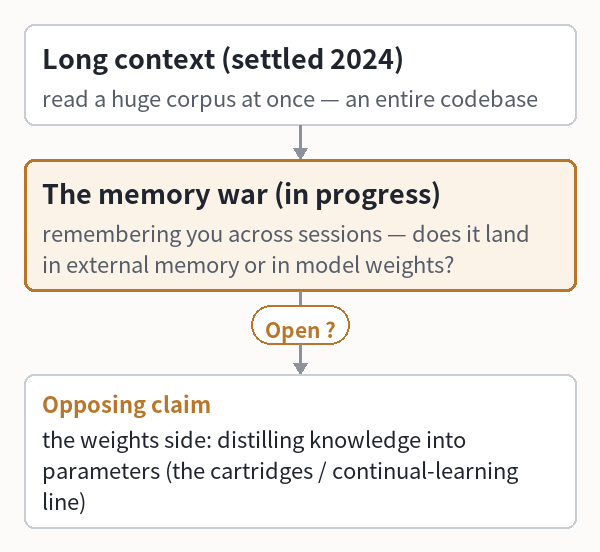
The call this brief has already made: the memory war is unsettled, and current evidence leans toward the context side. "Context" here means the working window the model can read right now; explicit memory is, at bottom, the engineering of continually putting what matters back into that window. The most direct mechanistic evidence: today's naive approaches to writing facts straight into model weights are wildly unstable — what gets written in is washed away by subsequent training, while the same facts placed back in context remain almost fully usable. What would prove this wrong (the threshold is this brief's own tracking standard, not an external one): if within 12 months two or more frontier labs put weight-level memory writing into production services, this judgment is void and flips; verdict date July 14, 2027.
From the archive
The power shortage moves along a chain of bottlenecks, not one fixed point (our deep dive, July 4, 2026). "AI is short on power" usually gets told as one number; our deep dive in early July broke it into a chain: generation → interconnection (the approvals and engineering that put a power plant on the grid) → facility power distribution → cooling. The conclusion: the bottleneck is not fixed — it migrates along the chain, and the tightest link is never generation capacity; it is interconnection and facilities that can energize now. The opposing view was kept on the books from day one: NVIDIA CEO Jensen Huang argued in a March 2026 interview that the US grid runs at only about 60% of peak on average, with vast idle capacity 99% of the time; what's stuck isn't the electricity but a three-way standoff: customers demanding zero downtime, data centers refusing to run degraded, and utilities not selling tiered supply (Lex Fridman Podcast, Mar 2026). The reconciliation was this brief's synthesis judgment at the time: the quality of power (on demand, never interrupted) is scarcer than its quantity, and average idle capacity cannot save a load that surges and stalls the way AI does. Today's story 5 — "assets that can energize now are priced at the very front of the curve" — is that two-week-old judgment echoing back from the market.
Sources and coverage
The past 24 hours. At 21:30 last night we scanned 155 new items: 100 X posts, drawn from the original posts of the 305 accounts we track rather than a full-network scan; 36 blog posts; 10 podcast transcripts, including this issue's mainstays — five episodes of The Cognitive Revolution, plus All-In and 20VC; 6 academic papers from arXiv; and 3 newsletters, including Exponential View and Ahead of AI. All of it was ingested with nothing dropped; FRED, the macro data source that timed out the previous day, recovered overnight, but no new official data was released, so this issue has no macro section. Overnight we processed the top 32 items under a conservative bar (four categories: podcast transcripts, academic papers, X originals, newsletters); during the day we read 5 more from the academic long tail, kept 3 and filtered 2 — the filtered ones were narrow-domain methods papers with no new signal, to save you the trouble — and did same-day official verification of the Databricks raise. No new tracked sources today, and no one-off backfills; the four early-July interviews are simply older episodes from routine podcast ingestion, each marked with its event date, not passed off as today's news. Coverage statement: this issue can only vouch for signals within those 155 items.
The sources we track. This brief's judgments rest on 529 named voices we currently follow: 305 on X (Elon Musk, Andrej Karpathy, Greg Brockman, Nathan Lambert, and others), 90 podcast voices (Satya Nadella, Dario Amodei, Jensen Huang, and others), 51 news outlets, 48 personal blogs (Simon Willison, Chris Olah, and others), 48 paper authors (Noam Shazeer, Percy Liang, Tri Dao, and others), 46 newsletters (Dylan Patel, Ben Thompson, Ethan Mollick, and others), 26 companies' earnings and filings, and 23 keynotes.
This is not a news digest: we hunt each day's AI firehose for the insights that actually matter and the expert judgments worth tracking long-term, and we show how each one was verified. The point is always "which call got harder to dispute, and who called it right" — not "what happened today."
—— SecondSource · generated by our research system · 16 sources · replying to this email is the best feedback you can give
Written from the same research and judgments as the Traditional Chinese edition; every claim links to a primary document.
EN English edition|繁 中文版 Traditional Chinese →