
SecondSource Daily Brief · 2026/7/17 | "AI narrows the quality gap to average" just passed peer review — but where work has no answer key, the gap widens instead
Material for this issue: our research brief of 2026-07-17. Most of it happened on 07-15 and 07-16 — official announcements from Intel and ASML, the Kimi K3 launch, a Menlo Ventures exclusive, several first-person posts — plus three catch-ups: SK Hynix's listing on 07-10, a defense roundtable recorded in April filed under "trend watch," and the deep dive we finalized last night. A concentration note: one aggregator-media family supplied nearly a third of this issue's material, and one commentator, Nathan Lambert, appears at four separate points. Every concentration is flagged in the text, and multiple judgments from the same source are never treated as corroborating each other.
This is not a news digest. We hunt the daily AI firehose for insights that actually matter and practitioner judgments worth tracking over time, and we show how each one was verified — the point is always "which call just got harder to dismiss, and who is calling it right," never "what happened today."
The intake, past 24 hours
Last night's 22:27 scheduled pull completed with zero failures: 276 new items — 153 X posts, 58 blog posts, 50 academic papers, 8 newsletters, 6 podcasts, 1 corporate filing. The midnight automated batch processed the 32 highest-priority items under conservative standards; the early-morning automated deep-dive run produced a draft report that a human finalized during the day. We also re-reviewed 5 items the night shift had flagged "no signal" and overturned 3 of them. No new tracked sources today, no one-off backfills. Coverage statement: last night's log records only category totals, so this issue can vouch only for signals within those 276 items; the X intake covers original posts from 160 tracked accounts, not a full-network scan.
Today's leads
1. [This week] Intel, not TSMC, is the first to run the next-generation lithography machine inside a production line. ASML and Intel officially announced on 07-15, the same day: Intel's Panther Lake laptop processors are built on its 18A process, and some of their circuit layers are now patterned with High-NA EUV lithography machines. Yields match the previous-generation tool (Intel's own claim), the laptops carrying these chips are shipping now, and they are the world's first production chips printed on this class of machine (More Than Moore, 07-15). Two definitions first: an EUV lithography machine is the tool that "prints" circuit patterns onto silicon wafers — it decides whether chips can keep shrinking at all; High-NA is its next generation, roughly US$380M per machine, and ASML is the only company on Earth that can build one. The reporter, Ian Cutress, is a former senior chip journalist at AnandTech, and the historical reversal he points out is the best part: on the previous EUV generation, Intel dragged its feet and TSMC ran away with the lead; this time Intel is in front, while TSMC has bought machines to test but still won't commit to adoption through 2029. Verification: two primary official announcements — ASML's and Intel's — corroborate each other, with an on-scene journalist filling in detail, so the event itself is solid; "yield parity" is still Intel's own claim, and the incentive should be kept in mind. One caveat pours cold water on the cost side, from a model estimate by the semiconductor research firm SemiAnalysis: a High-NA exposure costs roughly 2.5× the older tool per pass, and won't pencil out for most circuit layers until around 2030 — this Intel run is early practice, and 18A was designed to ship without High-NA anyway. Judgment update: the "Intel comes back on 18A" storyline we track long-term just got its first physical evidence from a production line, rather than roadmap promises; and as of today, TSMC's conservative path has a control group.
2. [This week] (event date 07-10) The supplier of AI's scarcest component just completed the largest foreign-company IPO in US history. SK Hynix raised $26.5B in a Nasdaq depositary-receipt listing, surpassing Alibaba's $25B in 2014 to become the largest US listing ever by a foreign company; shares priced at $149, jumped 13% on day one to close at $168.01, and have since pulled back (TechCrunch, 07-10). Why it matters: HBM is stacked high-bandwidth memory, and how fast an AI chip computes depends on how fast memory feeds it data — which makes HBM the scarcest, priciest component in an AI accelerator. SK Hynix leads the market at 56.4% share, with customers including Nvidia and Apple. Until now it traded only in Korea, effectively out of reach for US retail investors — and a 20VC roundtable — the VC interview podcast — added a telling detail: the same stock trades roughly 20% higher as a US depositary receipt than in Seoul, and that premium is itself evidence of demand (20VC, 07-16). Verification: the listing numbers were reported by multiple financial outlets on 07-10 and cross-check; the "operating margin around 70%" figure is a podcast relay, reference only. Judgment update: read together with item 1: two upstream links in the AI compute supply chain — lithography tools and memory — each cemented its position this same week, one entering a production line, the other tapping into the pool of dollar capital. The competitive implication: SK Hynix was already the HBM leader at 56.4% share, and access to US capital stretches its lead over Samsung and Micron another notch; downstream, buyers like Nvidia see their dependence on a single dominant supplier deepen further. The boundary: memory is a brutally cyclical business, and fat margins invite capacity expansion — don't read this as one-sidedly bullish.
3. [Today] An old-line VC remade by a single Anthropic position is an extreme case of pressing a winning bet. Venture journalist Eric Newcomer (formerly of Bloomberg) reported an exclusive yesterday: Menlo Ventures has put roughly $1B into Anthropic since 2023 — the largest single investment in its 48-year history, ten times its second-largest — and the stake is now worth about $14B (Newcomer, 07-16). The valuation basis needs stating: that $14B is paper value marked to Anthropic's $965B post-money valuation from its May raise — nothing has been exited, nothing has IPO'd, and it shrinks if the valuation corrects. On the strength of that one position, Menlo — whose prior two funds were middling — closed a $3B fund last month, the largest in its history; the core numbers were independently reported by Bloomberg in June (Bloomberg, 06-23). The claim that recent funds run "north of 40% annualized returns" traces to a single anonymous internal document; we have seen no other source, so treat that number as reference. Verification: the cumulative investment and the new fund check out independently against Bloomberg and TechCrunch; the return figure has no second source. Judgment update: AI's spending is concentrating and its returns are concentrating — two faces of the same capital network, consistent with the "AI capital concentration" theme this brief tracks; it is a single case, and we do not extrapolate it to the venture industry. To confirm or break this concentration call, watch two dials: whether Anthropic's next round marks up or corrects, and how Menlo's $3B fund actually performs.
4. [Today] Meta showed two faces in one day: buying the best, selling cheap. The buy side: tech analyst Ben Thompson, relaying industry talk on his own podcast — "They are reportedly Anthropic's biggest customer. They shovel billions of dollars a year to Anthropic," referring to Meta's spend on writing code (Sharp Tech, 07-15). That is a single relay with no primary confirmation of any kind; read it as a directional signal only. The sell side is checkable: Meta's budget model, Muse Spark 1.1, now has a price. First, the billing unit: a token is the smallest slice of text an AI model processes and bills on — roughly a short fragment of a word or phrase. Muse Spark 1.1 is priced at $1.25 per million tokens in, $4.25 out, which press coverage frames as roughly a quarter of OpenAI's and Anthropic's frontier rates (Bloomberg, 07-09); yesterday Zuckerberg personally announced its listing on OpenRouter — the third-party aggregator where developers compare prices and switch between vendors' models with one click (X / @finkd, 07-16). A capability footnote: an agent is an AI system that plans and calls tools on its own to finish a task; SemiAnalysis rates Muse Spark's general agent ability as mediocre — "cheapest" is not "best." Verification: the pricing and the listing rest on multiple outlets plus the principal's own post; the buyer narrative and the seller positioning both come from the same podcast episode — read them together, but they do not corroborate each other. Judgment update: yesterday's deep dive (our 2026/7/16 issue, on OpenAI raising next-generation model prices 2×) argued that the AI coding market should be read through the lens of task difficulty — the same player can be a buyer at the hard end and a supplier at the easy end. Meta today is that framework's textbook case. A countable metric: the number of first-tier giants with their own models listed on aggregator platforms is the dial on how far "models as interchangeable parts" has climbed.
5. [Today] A Chinese open model cracks the top tier for the first time — and prices low. Moonshot AI officially released Kimi K3: a self-reported 2.8T-total-parameter mixture-of-experts architecture — the model splits into 896 expert subnetworks and wakes only 16 per token, so you get huge capacity but pay for only a sliver of compute each step — priced at $3 per million tokens in, $15 out, with model weights promised public on 07-27 (AINews, 07-16). Two independent evaluators supply coordinates: Artificial Analysis's composite intelligence index (2026-07 snapshot) scores it 57, where on the same scale Fable 5 is 60, GPT-5.6 is 59, and Opus 4.8 is 56 — the first open-weights model inside that band; on LMArena's human-blind-vote frontend-coding leaderboard (2026-07 snapshot), it jumped from its predecessor's #18 to #1 in the world. The honest column goes on record too: its hallucination rate worsened from the prior generation's 39% to 51%, and Moonshot itself concedes the user experience still clearly trails the best. Verification: the release is established; on capability, two independent evaluations cross-check, so it counts as multi-source. The spec numbers are all official self-reports and the technical report isn't out. The material reached us via the aggregator AINews; we have not verified each original evaluation post individually. Judgment update: on the "can open weights catch the frontier" storyline, K3 is the heaviest weight yet on the scale; but benchmark scores are easy to optimize against, and real-world experience beyond the leaderboards needs a few weeks to settle. As for who would actually use it: K3's intelligence score isn't the highest and its price isn't the lowest — its niche is teams that prefer self-hosting, need sovereignty or compliance, or want out of the US supply chain. It is an "Opus-class capability at near-Sonnet price, with open weights" option, and the decision turns on whether you can self-host and own the weights, not on leaderboard rank. One reminder: 2.8T parameters take 64-plus accelerators to serve — open weights do not mean cheap to run.
6. [Trend watch] (roundtable recorded 2026-04; transcript read last night) For the first time, someone put a dollar figure on AI-launched cyberattacks. A ChinaTalk defense roundtable — the US-China tech and security policy podcast — relayed Anthropic's figure: roughly $20,000 of compute now produces a very strong chain of exploits (ChinaTalk, recorded 2026-04). For comparison, the dark-web market: a zero-day — a vulnerability the software vendor itself doesn't yet know exists — has historically sold for six figures apiece, each one hand-built by elite teams. The two numbers are different units and must sit side by side: $20,000 is a production cost, six figures is a market price; you cannot divide one by the other for a return — and the panelists themselves admitted they weren't sure they had the number right. If the order of magnitude holds, the scarce asset in offense shifts from "keeping an elite team" to "a cloud bill" — the panel's own image was "ten guys who got some API credits or whatever." Their endgame is cold, too: in a world where defense can't hold, the panel's projected response is network partitioning and a retreat to physical isolation, not deterrence. Verification: this is the only source we have seen, and the participants admit uncertainty — take the direction, not the precise figure, as the signal here. It is the first economic cost figure the AI-and-security beat has produced. Judgment update: This mirrors today's deep dive: AI levels work that has an answer key — and attack happens to have one (either you got in or you didn't); defense doesn't. The same dividing line, standing on both sides of the fight. Two signals to watch: whether the $20,000 magnitude gets pinned down by an independent source, and whether the panel's projected equilibrium — infrastructure fragmentation, a retreat to physical isolation — actually materializes. The number remains single-source and shaky by the panel's own admission; read it as direction, and don't rush to rewrite your security architecture.
7. [Evidence update] May's "government-versus-Anthropic standoff" now has a second independent mention. The event itself still rests on a single relay: a16z partner Martin Casado said in mid-June that the government demanded Anthropic CEO Dario Amodei patch a certain jailbreak or face having the model taken down, and Anthropic refused (X / @martin_casado, 06-13). In a ChinaTalk interview we finished reading last night, former Biden-administration China official Julian Gewirtz touched the same event from the other end: the administration, he said, "had sort of a spectacular blow up with the AI company Anthropic that possesses the world's best models right now," arguing the US "used this period of de-escalation not to build up our own strengths but actually to undermine them further" (ChinaTalk interview, source page undated). The interesting part is that the two men stand on opposite sides — one faults Anthropic, the other faults the government — yet they point at the same event: the facts corroborate, while each interpretation gets discounted on its own. Verification: both sources are secondhand relays and there is still no primary confirmation of any kind; credibility stays medium-low. As of our last check there was no official follow-up from either side (not re-verified this issue). Judgment update: the factual layer upgrades to mutually corroborated on this second independent mention; the interpretive layer has two opposed readings, each discounted; our tracking call on the episode is unchanged — medium-low credibility, short of primary confirmation. Watch for: any on-record statement from Anthropic or the administration — until then this stays a two-sided he-said/she-said with no primary source on either end.
The deep dive
Three years ago BCG ran that 758-person experiment; this March it landed in a top management journal — and the deep dive we finalized last night re-audits it against three years of evidence since. The original design randomly split consultants into groups with and without GPT-4 access: the bottom half improved quality by 43%, the top half by 17%, and the top-bottom gap shrank from 22 percentage points to 4 (Organization Science, published 2026-03); the same directional result has now passed peer review in replications across four domains — writing, customer service, legal, and creative writing. The core judgment: the leveling is real, but only on tasks with a quality template — where the template disappears, the effect reverses. The hardest counterexample comes from Kenya: 640 small-business owners used GPT-4 as a business advisor for months; split by pre-experiment performance, the high performers gained +15% in profit while the low performers lost −8% — the gap widened (Management Science). The difference wasn't in answer quality; it was in which advice they picked and how far they executed — judgment did not get leveled. The third line runs at the market layer: large-scale US payroll data shows that in the occupations most exposed to AI, relative employment of 22–25-year-old entry-level workers fell 16% while seniors in the same occupations held steady (Stanford Digital Economy Lab, 2025-11). The report's unifying read: leveling = commoditization — pay in the leveled band drifts toward the price of a tool subscription, and the human premium migrates to verification, judgment, and accountability. That last step is an inference, not verified causality; keep that firmly in mind. One footnote: the most-cited study arguing "AI benefits top performers most" — in May 2025, MIT formally stated it had no confidence in the data and asked for the paper's withdrawal (TechCrunch, 2025-05).
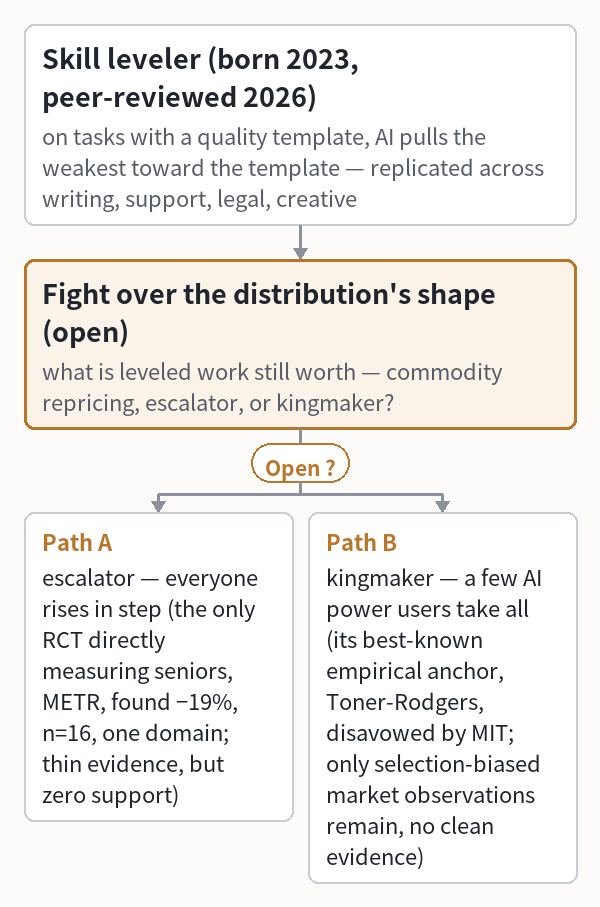
What would prove this wrong (our self-set 12-month window; verdict date 2027-07-17): one, a clean leveling replication appears in a domain with no template, which would force us to revise "the judgment layer doesn't level"; two, if entry-level decline of the same magnitude shows up in occupations where AI does the work for you, the commoditization reading is overturned; three, the "few winners take all" script reopens should large-sample wage data, controlling for tenure, still show the pay premium of AI power users widening.
The above is the condensed version — the full deep dive goes out tonight at 7:30 US Central, to this same inbox.
Chips & semiconductors
This column's two big events today — the lithography milestone and the memory IPO — carried enough weight for the leads and are covered in items 1 and 2 above; we won't repeat them. One pending lead to add:
- [Today] [Pending lead] Google says Intel is adopting its enterprise AI-agent platform Gemini Enterprise company-wide — "including to speed up the development of next-gen semiconductors." That phrasing is verbatim from Google CEO Sundar Pichai's post (X / @sundarpichai, 07-16); the marketing register is obvious, there is zero corroboration from Intel's side, and the deployment's scope and depth are entirely unknown — we file this as a pending lead, not a fact. Why it's worth a slot in the queue: "AI accelerating chip design" has been talked about for years with no named, large-scale case — if Intel confirms, this would be the first.
Notable calls
- Nathan Lambert (Ai2 researcher, author of Interconnects), 07-16 on X. Two calls (source): first, "companies will keep making open models longer than you expect because money will keep pouring into AI," and consolidation "isn't something that'll happen rapidly (at least in the near term)" (direct post) — he cites the simultaneous pile-up of K3, GLM 5.2, Inkling, and the new DeepSeek release as evidence; second, "I'm a lot more confident in inference companies / companies with O(B) revenue becoming neolabs faster than many neolabs become functioning businesses" (direct post) — inference companies here meaning firms that make money hosting other people's models behind an API; revenue and distribution are the harder half to build. Caveats: he is a public advocate for open models, so his stance and his judgment point the same way; and he already appears in this issue's K3 positioning, so multiple judgments from one person do not corroborate each other here. Both calls run in the same direction as the pending judgment in our 2026/7/16 issue (on OpenAI's 2× next-generation price hike) — that services monetize first while models become customer-acquisition assets — but since they come from the same person, credibility does not compound.
- Harrison Chase (LangChain CEO), 07-16 on X. His frame is "own your intelligence": the durable advantage now is not the strongest model at any given moment — "the durable advantage is not the model/system at this point in time - it's the flywheel that compounds over time," and "owning that feedback loop (the signals, the output)" is what owning intelligence really means (source; direct post). Caveat: what he sells is exactly the tooling layer above the model, so stance and thesis point the same way; this ties into the integrator-versus-parts debate in yesterday's deep dive, and we file it as one interested party's testimony, not a verdict.
Models & research
- [Model-card read, 07-15/16] Two new models deviate from "standard attention" in the same week — a leading indicator at the architecture layer. Practitioners reading Thinking Machines' official model card for Inkling flagged a rare set of choices, most notably dropping RoPE — the positional-encoding standard nearly every large model shares, the mechanism by which a model knows which word comes before which — for relative position biases (AINews, 07-15); the same week, Kimi K3 shipped its in-house KDA attention — attention being the mechanism that decides which words the model weighs against each other, KDA short for Kimi Delta Attention — with an official claim of up to 6.3× faster decoding on very long inputs. Two labs daring to leave the standard recipe at large training scale in the same week is a signal of architectural diversification for the back half of 2026. The boundary: everything on Inkling comes from community readings of a single model card — one original source; and its "not distilled" claim — distillation meaning training a smaller model on a larger model's outputs — was self-corrected within the same discussion thread. Not a settled fact.
- [Named benchmark, 2026-07] Cheap tokens do not mean cheap tasks. Databricks benchmarked models on engineering tasks against its own multi-million-line codebase: Sonnet 5 is about 1.7× cheaper than Opus 4.8 per token, yet costs more per completed task — $2.09 per task for Sonnet 5 versus $1.94 for Opus 4.8 — because the cheaper model retries more rounds and completes 6 percentage points fewer tasks (Databricks blog, 2026-07; The Register also covered it independently on 07-13). The one-line takeaway for buyers: compare cost per completed task, not the sticker price.
- The honest note on the academic side: this week's academic main course is the five peer-reviewed papers inside the deep dive; among the 50 new arXiv papers from last night, nothing scanned so far clears the bar for inclusion, and we don't pad.
Product moves
- [Connected] Google let third-party search into its own agent platform. Google Cloud announced on 07-16 a partnership with Parallel Web Systems — a startup that builds search infrastructure specifically for AIs — plugging it into Gemini Enterprise as one of the supplier options enterprise agents can use to ground themselves in live web data (Google developers blog, 07-16). The directional signal: search is Google's home turf, and its willingness to let outside search infrastructure in for enterprise customers says that in the enterprise-agent theater, platform openness ranks ahead of defending the home business.
- [Connected] Agent "memory formats" just saw a standardization move. LangChain CEO Chase announced the same day that the collaborative knowledge-base tool OpenWiki is adopting OKF, an open knowledge format (X / @hwchase17, 07-16). One line of background: today every agent stores what it knows in its own incompatible format, so switching tools means amnesia; the people who care are teams building their own agent memory layer or wanting to move knowledge bases across tools. Someone pushing an open standard is a signal that "memory" is sedimenting into infrastructure. There are no adoption-scale numbers yet; read it as direction.
From the archive
A prediction from three months of tracking pays off: ChatGPT runs ads (a 2026-01 event; catch-up, optional reading). In 2025 this brief archived a structural call from analyst Ben Thompson: a free ChatGPT user brings in roughly $10 a year, a Google Search user roughly $100, and the only fix for a tenfold gap is advertising — as he put it at the time, "they hired Fidji Simo, which doesn't make any sense unless you're building an advertising company," referring to OpenAI recruiting the e-commerce advertising veteran. On 2026-01-16 OpenAI officially announced ad testing, and on 02-09 ads went live: placed at the bottom of the conversation, clearly labeled, with no influence on answers, paid users fully exempt, starting in the US, Canada, Australia, and New Zealand (OpenAI official, 2026-01-16; TechCrunch, 2026-01-16). In hindsight, that defensive design buys a low price per user — it won't close a tenfold gap. The next layer to watch: Google has said Gemini won't run ads; when your rival subsidizes models with ad revenue, how long does that promise hold? The value of this entry is the complete before-and-after: the call on record first, the event after, and the two line up.
Who we track
We currently track 529 named voices behind this brief's judgments: 305 on X (Elon Musk, Andrej Karpathy, Greg Brockman, Nathan Lambert, and others), 90 podcast voices (Satya Nadella, Dario Amodei, Jensen Huang…), 46 newsletters (Dylan Patel, Ben Thompson, Ethan Mollick…), 48 paper authors (Noam Shazeer, Percy Liang, Tri Dao…), 48 personal blogs (Simon Willison, Chris Olah…), 26 companies' earnings and filings, and 75 institutional blogs (NVIDIA, Google Research, SemiAnalysis, Hugging Face, and others).
— SecondSource · generated by our research system · 24 sources · reply anytime with feedback
Written from the same research and judgments as the Traditional Chinese edition; every claim links to a primary document.